A one-two punch approach to cancer treatment
Cancer remains difficult to treat, especially when disease is advanced. Combinations of different cancer drugs are used to suppress development of resistance, but such therapeutic approaches are often limited by toxicity. We have recently developed a radically different approach to cancer therapy which is not based on combinations of drugs, but rather on the sequential treatment with drugs, thereby avoiding drug combination toxicity. This approach will be developed further in a collaboration between the Netherlands Cancer Institute and Oncosence BV.
In this program we have identified novel targets for therapy that will serve as starting point for the development of innovative cancer therapies. The social and economic impact of fundamentally new and effective cancer therapies in four major cancer types is significant. The approach we used consisted of a “one-two punch” for the cancer cells. In this approach, cancer cells are first induced to stop dividing and acquire a major new vulnerability that is subsequently targeted by a second drug that selectively kills cells with the acquired vulnerability. To accomplish this, we took advantage of the notion that a cellular senescence response can be triggered in advanced cancers. Such senescent cancer cells have dramatic changes in gene expression and metabolism that might be exploited for their eradication. Using an animal model of liver cancer, we have delivered proof of concept that induction of senescence, followed by treatment with an agent that specifically kills senescent cancer cells, leads to dramatic anti-cancer responses. In this program, we have performed large-scale genetic screens in four major cancer types to identify novel genes whose suppression induces senescence or kill senescent cancer cells.
We have identified both novel agents that induce senescence in cancer cells, and agents that kill senescent cells. A remarkable finding was that the two agents we identified that kill senescent cells show strong synergy. We found that these agents have an ability to mobilize the host’s immune system which helps further in killing senescent cancer cells. We delivered proof of concept that these agents have potent anti-cancer activity in animal models.
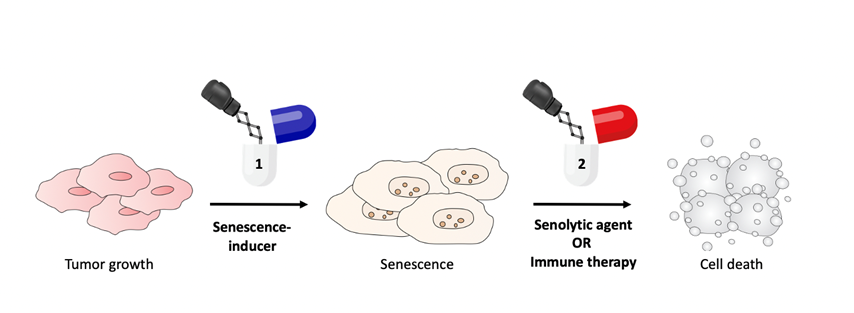
A one-two punch model for cancer therapy based on sequential drug treatment, exploiting induction of senescence as a stable cancer cell state with major acquired vulnerabilities that can be used to selectively kill them.