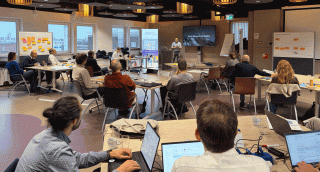
These are the Venture Challenge Winter 2025/26 MedTech teams!
Six teams have started the Venture Challenge Winter 2025/26 MedTech teams! These starting MedTech entrepreneurs will learn everything about building and pitching a business plan. By participating in the Venture Challenge, the teams will get a huge boost to take their idea to the next level. Not only will they receive one-on-one coaching, but they will also get the chance to pitch to investors and get in touch with seasoned entrepreneurs. The teams will be announced one by one. Meet the teams below!
Home Run - Making bloodwithdrawl as easy as flipping a switch
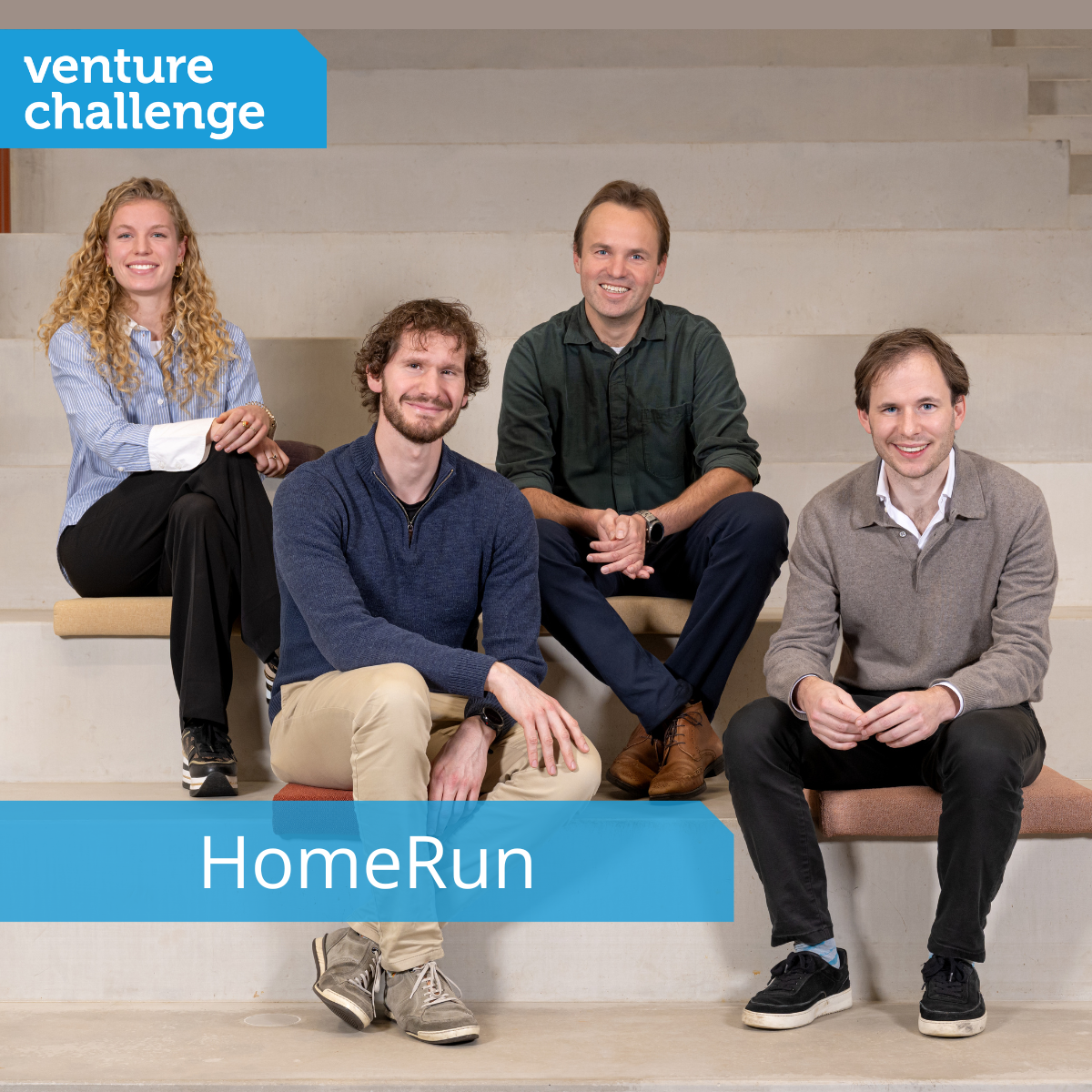
From left to right: Elise van Driel, Thom Joosten, Dirk Grünhagen, Teun Schurink
Frequent blood monitoring is critical for patients with chronic or oncological conditions, but traditional venipuncture can be painful, time-consuming, and requires trained staff. HomeRun is developing a painless, patient-friendly blood collection device designed for home use. This device enables self-sampling of capillary blood, making follow-up care more accessible and less burdensome.
Their initial focus is on colorectal cancer patients, where the device could reduce hospital visits, lower healthcare costs, and improve both patient adherence and comfort. Developed within Erasmus MC, the innovation brings together clinicians, engineers and health innovators to accelerate clinical validation and future market introduction.
VU-AMS - Your science-based stress monitor for daily life research
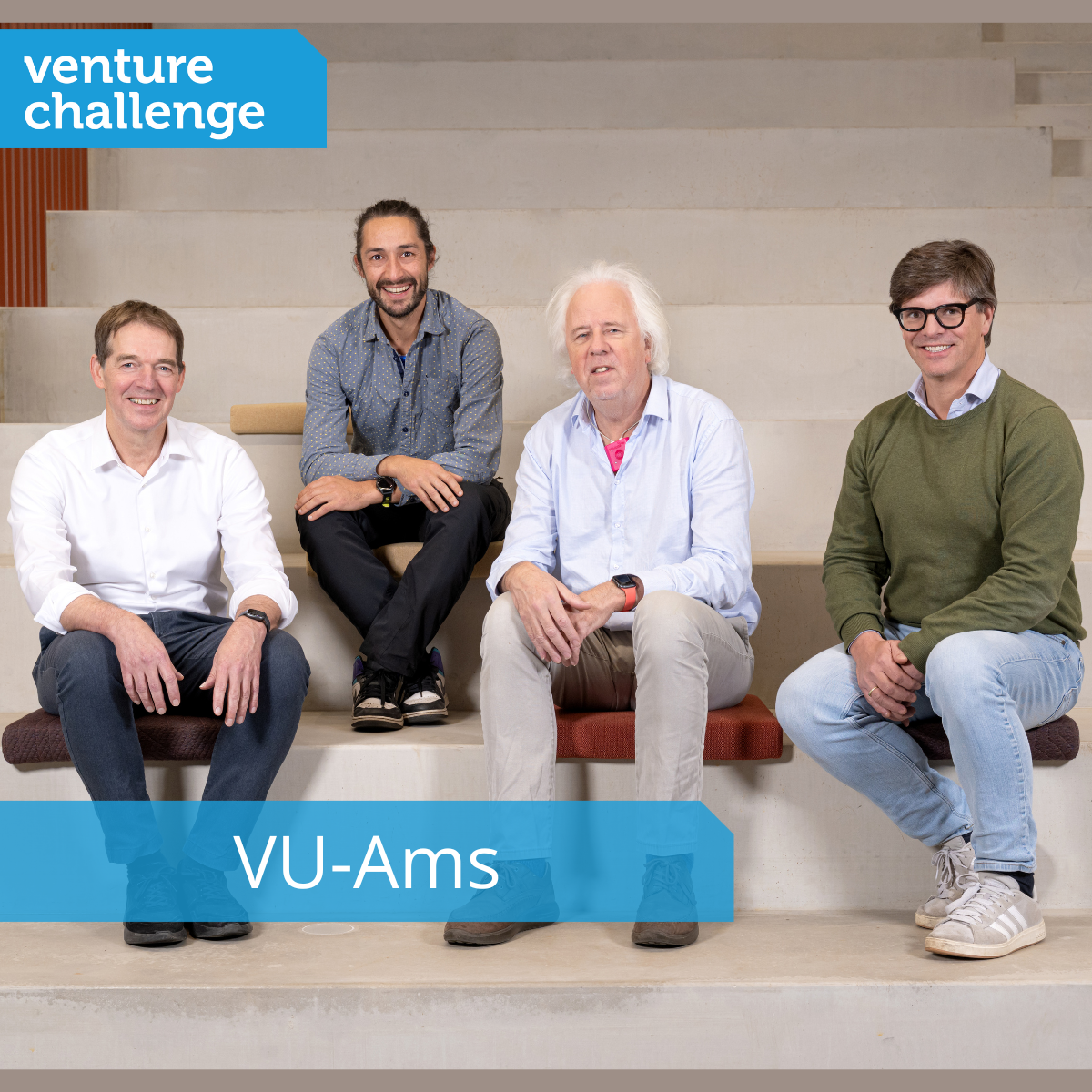
From left to right: Martin Gevonden, Eco de Geus, Cor Stoof, Ties van Rappard
VU-AMS offers physiological sensing and analytics solutions that lower the threshold for integrating physiological measurements into behavioural and clinical science. Their technology enables researchers to collect valid, real-world data with minimal burden to participants.
Already used in academic research, VU-AMS holds strong potential for expansion into corporate R&D (e.g. Nike, Unilever) and medical fields such as cardiology, psychiatry, occupational medicine and psychology. By facilitating daily-life stress monitoring, VU-AMS supports the prevention of stress-related illness and paves the way for next-gen research and diagnostics.
GlobalLimb– Quality prosthetic care for everyone, everywhere

From left to right:Dolf Wittkämper, Merel van der Stelt, Iris Sterkenburg
Globally, around 35 to 40 million people require prosthetic or orthotic care—a number expected to rise due to diabetes, population growth and conflict. A key challenge lies in creating well-fitting prosthetic sockets that ensure comfort and mobility.
Global Limb is developing 3D Pro Flow: an end-to-end, AI-powered solution that automates and simplifies socket design. The software is trained on a database of expert-designed sockets and integrates 3D scanning, 3D printing and a training program suited to diverse healthcare settings. This innovation aims to make high-quality prosthetic care more accessible and scalable—especially in low- and middle-income countries—while improving production time, fit, and user satisfaction worldwide.
UCANACT – Turning intent into digital actions for those with motor disability

From left to right: Phoebe de Nooijer, Julia Berezutskaya
Not in the photo: Mariska van Steensel, Akshaj Verma
Over 2 million people worldwide live with severe motor disability due to stroke, trauma, or neuromuscular disease. These individuals often struggle to walk, use their hands, or speak. UCANACT is developing brain-computer interface (BCI) software that translates brain signals into digital commands, enabling control of personal devices and smart home systems—restoring autonomy and quality of life.
As BCI hardware continues to evolve rapidly, UCANACT addresses the growing need for reliable, multifunctional, user-centered software. The team brings together clinical experience, AI and signal processing expertise, and in-depth understanding of user needs to make digital independence a reality.
AquaWomb – Give every preterm born baby a better start for life

From left to right: Marcel Quist, Guid Oei and Myrthe van der Ven
Each year, 15 million babies are born preterm—before 37 weeks of gestation—placing them at risk for serious complications. For extremely preterm infants (born before 26 weeks), the situation is especially critical, with a global mortality rate of 40% and high chances of lifelong health and developmental problems.
AquaWomb is developing a pioneering solution that reimagines neonatal care. Their perinatal life support (PLS) system mimics the natural womb environment by continuing to use the umbilical cord, connecting the baby to an artificial placenta that supplies oxygen and nutrients. Instead of forcing immature organs to function in an air-based incubator, the baby is protected in a liquid-filled environment that supports natural development.
By reducing the strain on fragile organs and extending their maturation period, AquaWomb aims to improve survival rates, long-term health outcomes, and reduce hospitalisation needs—giving preterm babies the gentlest possible transition into life.
Syntric Medical – CT-guided lung biopsies made safe and simple with effortless precision

From left to right: Géraud Zeitler, Joric Oude Vrielink and Christian Bijvoets
Lung cancer is the leading cause of cancer-related deaths worldwide, with 260,000 fatalities in Europe and 1.8 million globally each year. A major factor in this grim statistic is late detection and the difficulty of obtaining accurate biopsies—especially in early-stage disease. While biopsies are essential for confirming diagnosis and guiding personalised treatment, their success rate drops dramatically in early stages, from 96% to just 52%.
Syntric Medical is tackling this challenge by developing a solution that helps interventional radiologists achieve precise needle placement during CT-guided lung biopsies—even as patients breathe. Their technology is designed to increase the accuracy and safety of lung cancer diagnosis in early stages, with the potential to improve outcomes for millions of patients worldwide.
Source: LS@W