
Design and implementation of a novel RNA-based therapy to protect the kidney and lungs against coronavirus infections
The generation of effective antisense oligonucleotides to counteract SARS-CoV-2 infections
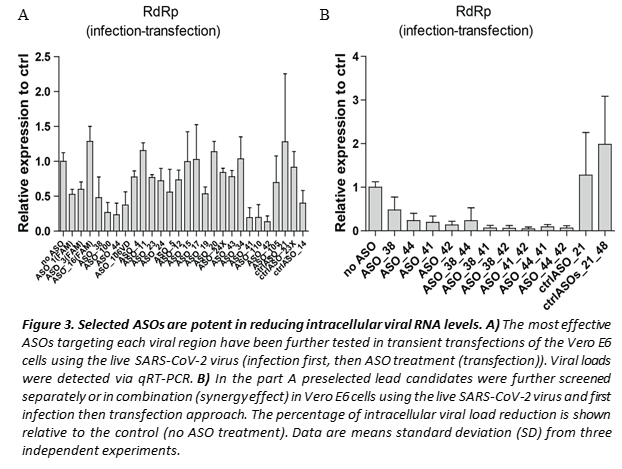
When vaccines against the corona virus SARS-CoV-2 were not yet available, many patients ended up in intensive care with severe pneumonia. There was also evidence that the virus could infect the proximal tubule cells of the kidney and patients were transferred to the dialyses department. In the context of a public (Internal Medicine, LUMC) private (Hybridize Therapeutics) collaboration, the applicants of this project had gained a lot of knowledge of antisense RNA (ASO) based antiviral medication for viral infections in the kidney that could also be effective. can be for respiratory infections. In collaboration with the Department of Medical Microbiology, we have demonstrated, based on our current understanding of the biology of the virus, that ASO technology can also be effective against SARS-CoV-2 infections.
We discovered the domains in the viral RNA that are most sensitive to ASO therapy and identified some ASOs (“lead compounds”) that can inhibit viral replication in the laboratory by approximately 96%. With the great success of the COVID vaccines and the milder course of the recent omicron variants, our impact in particular lies in the fact that we have developed a technology that can potentially be used as ‘a first line of defence’ against future new RNA virus epidemics. The technology to prevent the multiplication of viruses with an “antisense” RNA molecule can be applied in sprays to protect the respiratory tract for a long time or can be administered intravenously in the case of infections of the kidney or liver.
Andere projecten
In elk PPS-project werken kennisinstellingen, bedrijven en zorgpartijen samen aan een concrete gezondheidsvraag. Bekijk het volledige projectoverzicht.


Bekijk de programma’s
Binnen onze programma’s werken bedrijven, kennisinstellingen en regionale partners samen aan innovaties die bijdragen aan betere gezondheid en zorg.
Bekijk de partnerschappen
Strategische publiek-private partnerschappen (PPP's) zijn meerjarige samenwerkingen tussen bedrijven, kennisinstellingen en andere partijen.
Hoe kunnen we je helpen?
Heb je een vraag of wil je meer weten over Health Holland? We brengen je graag in contact met de juiste mensen, kennis en mogelijkheden om gezondheidsinnovatie te versnellen.
We hebben uw bericht ontvangen
We nemen binnen 3 tot 4 werkdagen contact met je op. Is je vraag dringend? Neem dan gerust direct contact met ons op. Hieronder zie je de contactoptie die het beste past bij je onderwerp.
Opnieuw beginnen
Er ging iets mis bij het versturen van het formulier. Probeer het opnieuw.