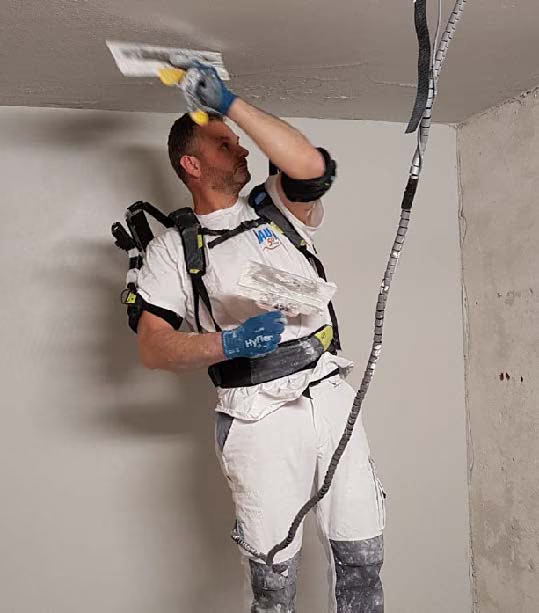
Technical support by exoskeletons for construction workers.
Exoskeletons might Arm-support exoskeletons may lower the biomechanical load on low back and shoulders, but this is highly depending on the type of tasks and postures and movements involved
Many construction workers are exposed to heavy work and health risks. This project focused on plasterers, gypsum block, and dry wall installers, and on various technologies: mainly back- and arm-support exoskeletons. For these professions, they analysed the working process, tasks and activities and associated health risks. All three professions show a need for support to protect the workers for low back or shoulder injury. Based on a scan, they selected a back-support exoskeleton for the gypsum block and dry wall installers and an arm-support exoskeleton and a gypsum nozzle for the plasterers to be tested.
As the working activities for gypsum block and dry wall installers were diverse, the potential effectiveness to reduce the work load of the back-support exoskleton as well as their acceptance was low. The arm-support exoskeleton and gypsum nozzle for the plasterers did show good potential.
For the plasterers this project conducted an experiment in which various plastering tasks were performed at ceiling and wall, with exoskeleton (Skelex) (Exo) and without (NoExo). EMG was recorded of six muscles involved in arm elevation, four agonists and two antagonists, and plasterers rated their perceived exertion (RPE). In all tasks, the EMG amplitudes of three agonist muscles were lower in Exo vs NoExo. None of the antagonists (Triceps Brachii, Pectoralis Major) showed increased EMG values in the Exo condition. RPE’s were lower in Exo condition for all tasks, except for ‘applying gypsum to the wall’. Thus far, passive arm support exoskeletons have mainly been tested in lab studies on single postures or movements. In reality, working tasks generally involve multiple movements. This study investigates the effectiveness of an arm support exoskeleton in work that requires multiple arm movements. Muscle activity, as well as perceived exertion were both reduced when working with an exoskeleton.
Other projects
In each PPP project, research institutions, businesses and healthcare organisations work together on a specific health challenge. Browse the full project overview.

Bekijk de programma’s
Binnen onze programma’s werken bedrijven, kennisinstellingen en regionale partners samen aan innovaties die bijdragen aan betere gezondheid en zorg.
Bekijk de partnerschappen
Strategische publiek-private partnerschappen (PPP's) zijn meerjarige samenwerkingen tussen bedrijven, kennisinstellingen en andere partijen.
Hoe kunnen we je helpen?
Heb je een vraag of wil je meer weten over Health Holland? We brengen je graag in contact met de juiste mensen, kennis en mogelijkheden om gezondheidsinnovatie te versnellen.
We have received your message
We will contact you within 3 to 4 working days. If your question is urgent, please contact us directly. Below is the contact option that best matches your subject.
Start again
Something went wrong while sending the form. Please try again.