Precision Medicine for more Oxygen (P4O2)
Understanding early development of lung disease for prediction and prevention
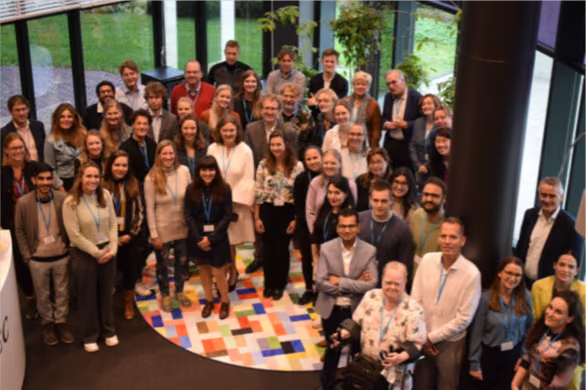
Within the P4O2 project, we have brought together a network of lung researchers, healthcare providers and companies that work on products for people with lung disease. Within this network, we work on early detection of lung diseases and on finding new targets for treatment and diagnostics.
In the project, we have built research cohorts. The Sherlock (COPD) cohort has been expanded to 580 people. In the PARASOL cohort (people without a diagnosis of lung disease, partly with an increased risk), 291 people have been included. The ILD cohort has started and 8 patients have now been included. Ortec Logiqcare has used its LogiqSuite Medical Data Management System for this and optimized it for setting up the database.
New models have been developed that are used in the laboratory to study lung diseases preclinically. These models can be used for screening new interventions. These models can be marketed after further development.
Data has been generated and knowledge has been gained within the various domains. Exposome: The (home) environment of the PARASOL participants has been mapped. Omics: The microbiome and transcriptome of the PARASOL cohort have been determined. Sequencing and proteomics have been performed in the Sherlock cohort. Imaging: 143 participants have had a CT scan of the lungs and upper abdomen Lifestyle intervention: our research into the willingness of people without lung diseases to participate in a lifestyle intervention has shown that this approach is of interest to the target group.
Companies and researchers can use this knowledge to eventually develop new therapies and diagnostic tools for lung diseases.
Other projects
In each PPP project, research institutions, businesses and healthcare organisations work together on a specific health challenge. Browse the full project overview.

Bekijk de programma’s
Binnen onze programma’s werken bedrijven, kennisinstellingen en regionale partners samen aan innovaties die bijdragen aan betere gezondheid en zorg.
Bekijk de partnerschappen
Strategische publiek-private partnerschappen (PPP's) zijn meerjarige samenwerkingen tussen bedrijven, kennisinstellingen en andere partijen.
Hoe kunnen we je helpen?
Heb je een vraag of wil je meer weten over Health Holland? We brengen je graag in contact met de juiste mensen, kennis en mogelijkheden om gezondheidsinnovatie te versnellen.
We have received your message
We will contact you within 3 to 4 working days. If your question is urgent, please contact us directly. Below is the contact option that best matches your subject.
Start again
Something went wrong while sending the form. Please try again.