
Lysosomes in motion: early non-invasive biomarkers for the detection of non-alcoholic steatohepatitis
New blood markers for early detection of obesity-associated liver inflammation
Currently, little is known about the risk factors driving obesity-associated liver inflammation (referred to as NASH), and non-invasive biomarkers to detect this global health threat are non-existent. By means of a strong, unique collaboration between three Dutch academic medical centres (MUMC+, UMCG, AMC), Antwerp University Hospital (UZA), Allergan (clinical-stage biopharmaceutical company) and Echosens (leading provider of non-invasive imaging devices), this project will identify novel, non-invasive blood markers to early detect NASH. All consortium partners are leading pioneers in the fields of hepatology, lipid metabolism and imaging, and are fully dedicated to performing clinical research in NASH.
Whereas most of the obese patients only have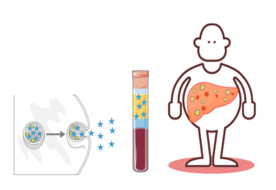 simple lipid accumulation in the liver, up to one-third is affected with NASH. In Western countries, NASH is becoming increasingly prevalent and is even seen in children. If left untreated, it can further progress to end-stage liver diseases, and, ultimately liver failure, underlining the need for liver transplantations. Therefore, this project aims at translating previous preclinical data into the clinic in order to decrease the long-term burden of NASH to society.
The implementation of novel, non-invasive biomarkers as diagnostic tools for NASH will not only reduce the need for liver biopsies, but also reduce the discomfort and complications for the patient as well as the time until diagnosis. Furthermore, it allows for the possibility to perform repeated measurements, enabling accurate monitoring of disease progression. It will also substantially improve our knowledge on the pathogenesis of NASH, thereby contributing to early prevention and future therapy for NASH. As such, successful completion of this project is expected to have high economic impact.
Altogether, the identification of specific, non-invasive biomarkers in combination with a non-invasive imaging device will allow us to earlier detect NASH and to better monitor disease progression both in adults and in children.
Other projects
In each PPP project, research institutions, businesses and healthcare organisations work together on a specific health challenge. Browse the full project overview.

Bekijk de programma’s
Binnen onze programma’s werken bedrijven, kennisinstellingen en regionale partners samen aan innovaties die bijdragen aan betere gezondheid en zorg.
Bekijk de partnerschappen
Strategische publiek-private partnerschappen (PPP's) zijn meerjarige samenwerkingen tussen bedrijven, kennisinstellingen en andere partijen.
Hoe kunnen we je helpen?
Heb je een vraag of wil je meer weten over Health Holland? We brengen je graag in contact met de juiste mensen, kennis en mogelijkheden om gezondheidsinnovatie te versnellen.
We have received your message
We will contact you within 3 to 4 working days. If your question is urgent, please contact us directly. Below is the contact option that best matches your subject.
Start again
Something went wrong while sending the form. Please try again.