Physiologically optimized plausible Co-Registration (POPCORN) for External Beam Therapy
POPCORN: A toolset for accurate image registration in contemporary external beam radiotherapy
Image-guided external beam radiotherapy (IGRT) plays next to surgery and chemotherapy an increasingly important role as one of the cornerstones in contemporary cancer care. A major complication is hereby constituted by anatomical and physiologic motion. Thus, motion compensation strategies are mandatory for all parts of the therapeutic work-flow to increase patient safety and to optimize therapeutic efficiency. In particular the increasing availability of image guidance, both in form of LINC systems with improved cone-beam CT guidance as well as the successful introduction of the MR-Linacs, unlocked entirely new possibilities to deal with physiological motion.
Although the recent time has seen a multitude of competitive methods for medical image registration, few of these algorithms address key-requirements such as (I) the possibility of image fusion of different medical imaging modalities and contrasts (such as various forms of computer tomography and magnetic resonance imaging), (II) conservation of very specific physical properties (Hounsfield units and delivered radiotherapy dose), (III) displaying a high degree of fidelity with respect to the true anatomical deformation and (IV) show very high performance for low-latency applications. Furthermore, clinical translation is frequently hampered by a lack of validation tools that provides the required confidence of mathematically derived biological motion estimates.
The “POPCORN” project was designed to address these specific needs by developing and expanding a set of novel image-based motion compensation solutions in tight collaboration with established industrial partners and therefore tailored with respect to the particular requirements of state-of-art adaptive IGRT systems. With a high number of peer reviewed scientific contributions, numerous conference contributions, pivotal influence of the recommendations for motion compensated IGRT (one PhD is first author of a consensus paper), a tight collaboration with Elekta as one of the leading IGRT device manufacturers and several follow-up projects in the pipeline, POPCORN has performed very successfully.
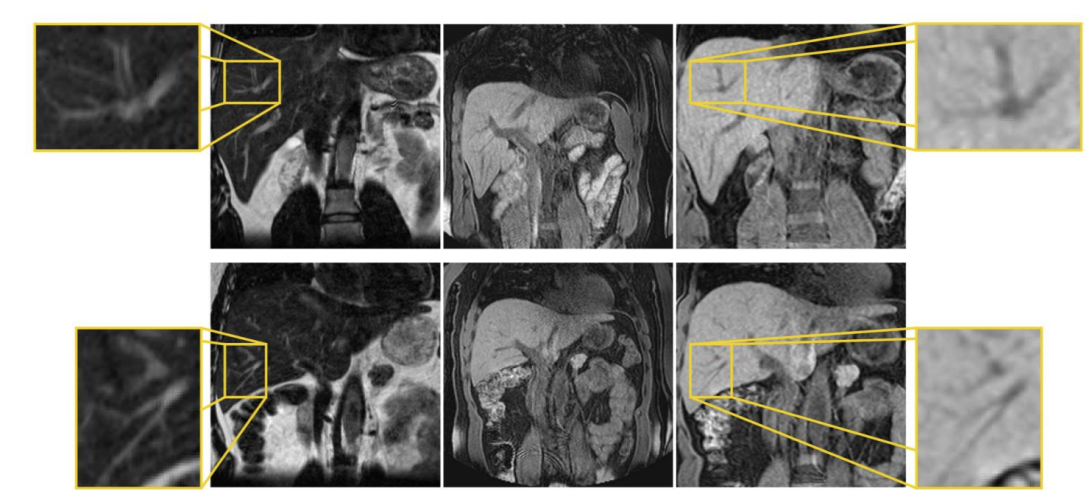
Caption: Two examples of abdominal cross-contrast image registration using the SOLID algorithm. Each row corresponds to a different case and depicts from the left to the right: The planning image in T2-weighted contrast, the therapy guidance image in a T1-weighted contrast and the image registration in a common frame of reference. Part of the vascular structure inside the liver has been magnified in the reference and registered images of each case.
Other projects
In each PPP project, research institutions, businesses and healthcare organisations work together on a specific health challenge. Browse the full project overview.

Bekijk de programma’s
Binnen onze programma’s werken bedrijven, kennisinstellingen en regionale partners samen aan innovaties die bijdragen aan betere gezondheid en zorg.
Bekijk de partnerschappen
Strategische publiek-private partnerschappen (PPP's) zijn meerjarige samenwerkingen tussen bedrijven, kennisinstellingen en andere partijen.
Hoe kunnen we je helpen?
Heb je een vraag of wil je meer weten over Health Holland? We brengen je graag in contact met de juiste mensen, kennis en mogelijkheden om gezondheidsinnovatie te versnellen.
We have received your message
We will contact you within 3 to 4 working days. If your question is urgent, please contact us directly. Below is the contact option that best matches your subject.
Start again
Something went wrong while sending the form. Please try again.