Cross-organ Human In-vitro Platforms for Metastatic Environments (CHIP-ME)
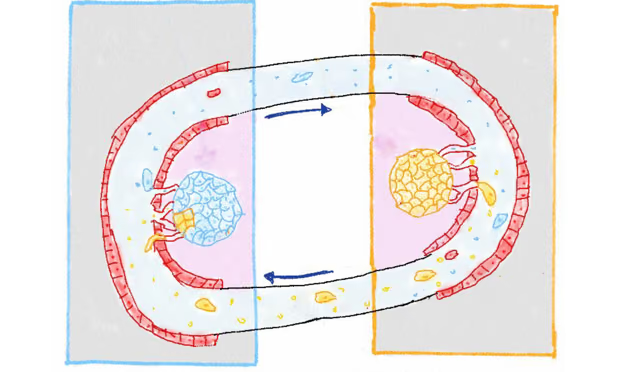
CHIP-ME aims at understanding how tumors communicate with other organs, and how this communication drives cancer spreading into distant organs
CHIP-ME aimed to understand cancer spreading, by studying the communication between a tumor and another organ. To address this ambitious goal, we set up a multi-disciplinary consortium combining one technical university (University of Twente), one university medical center (UMC-Utrecht) and three industrial partners (VyCAP, Fluigent, BEOnChip), with expertise in microfluidics, organ-on-a-chip and single-cell analysis.
Cancer, when associated with metastasis, remains a leading cause of death, with about 10 million deaths in 2018. However, how tumors spread remains an enigma, rendering the study and treatment of cancer challenging. Suitable mechanistic models addressing cancer-cell growth and spreading are however still lacking.
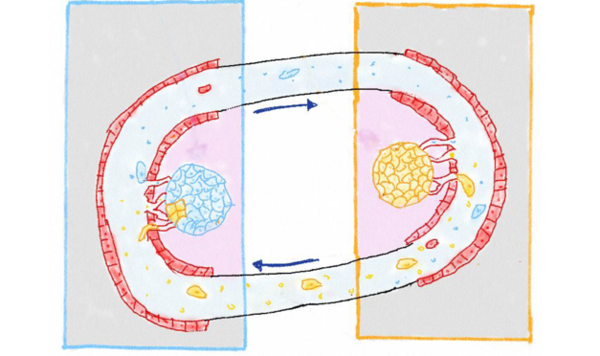
CHIP-ME’s approach was to develop a multi-organ platform, using microfluidics, 3D tissue-models, and vascular compartments, focusing on breast cancer metastasis to the bone. For this, we pursued a three-step plan in which (i) 3D cellular models were established for these tissues and (ii) a strategy developed for their vascularization, to yield two tissue-specific modules. Next, (iii), communication would be established between these modules to study inter-organ communication, which would be measured in terms of inflammation and cell extravasation.
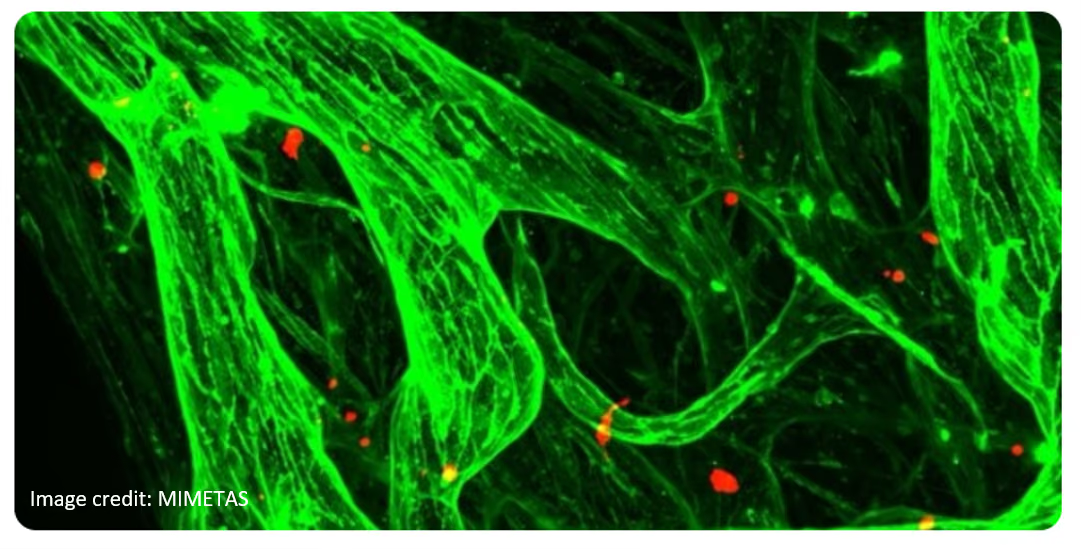
First, two 3D cellular models of breast tumor and bone, combining all relevant building blocks, have been developed, characterized, and introduced in microfluidic modules. For their vascularization, large blood vessels have been prepared and characterized using organ-specific endothelial cells, and an original strategy pursued to achieve 3D vascular networks. A dedicated recirculation set-up has been created to establish and study inter-organ communication. As a preliminary step toward this last goal, tumor-secreted substances have been perfused in the blood vessel model. Altogether, in CHIP-ME, we have developed technological tools (tissue-specific models, blood vessels, vascular network, recirculation set-up) to study breast tumor spreading into bone. Connecting these pieces is ongoing, before biological measurements can be conducted.
Other projects
In each PPP project, research institutions, businesses and healthcare organisations work together on a specific health challenge. Browse the full project overview.

Bekijk de programma’s
Binnen onze programma’s werken bedrijven, kennisinstellingen en regionale partners samen aan innovaties die bijdragen aan betere gezondheid en zorg.
Bekijk de partnerschappen
Strategische publiek-private partnerschappen (PPP's) zijn meerjarige samenwerkingen tussen bedrijven, kennisinstellingen en andere partijen.
Hoe kunnen we je helpen?
Heb je een vraag of wil je meer weten over Health Holland? We brengen je graag in contact met de juiste mensen, kennis en mogelijkheden om gezondheidsinnovatie te versnellen.
We have received your message
We will contact you within 3 to 4 working days. If your question is urgent, please contact us directly. Below is the contact option that best matches your subject.
Start again
Something went wrong while sending the form. Please try again.