
Optimal care at the right place: a multi-parameter, non-invasive wearable for home-based monitoring of vital signs to facilitate early relocation of care
Wearables that continuously monitor vital signs to provide post-myocardial infarction hospital-like care at the patients’ home
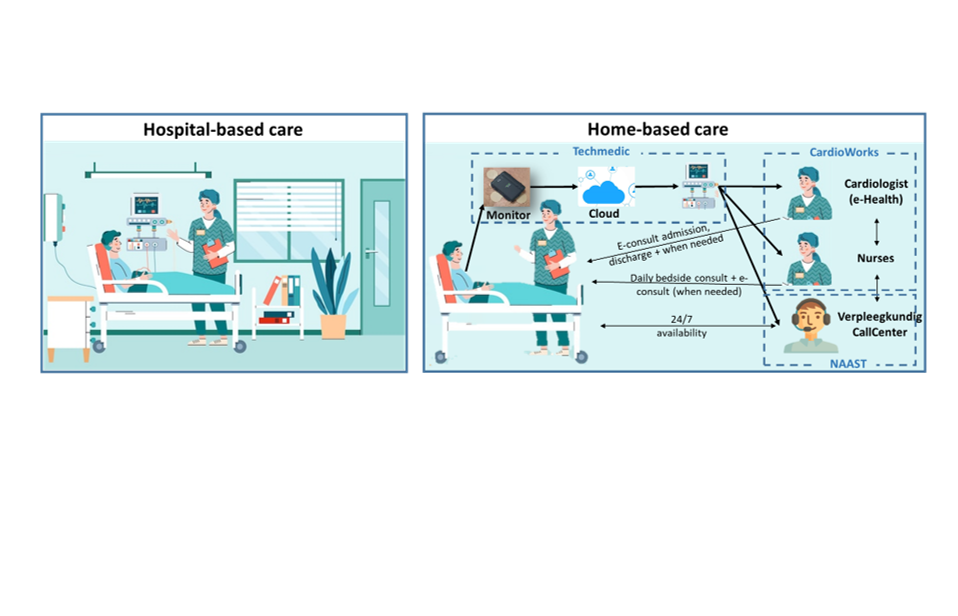
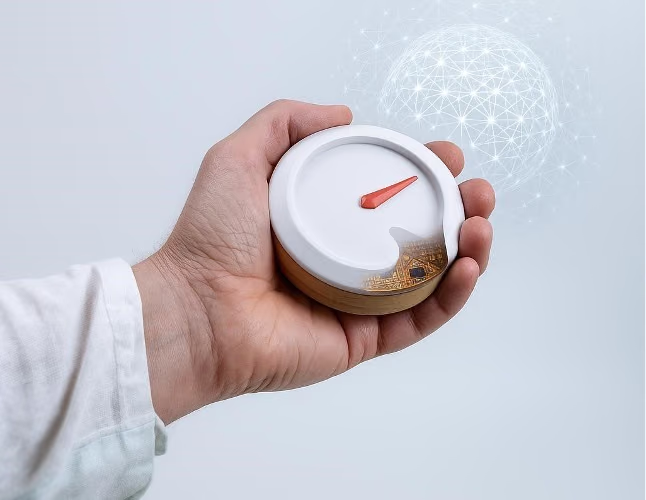
Patients with acute myocardial infarction or who underwent cardiac intervention (angioplasty) are in need for close monitoring, which represents a high cost and time-consuming care and typically performed within a hospital environment. In close collaboration between public private partnership, Radboudumc aims to facilitate early discharge from hospital and provide high-quality care within the home-environment for these patients. This will be done through using novel wearable to monitor heart rate and other vital signs (Techmedic), but also through sustainable connected care networks (NAAST, CardioWorks).
Patients with acute myocardial infarction or underwent cardiac surgery are in need for close monitoring, including heartrate and blood pressure, both at the coronary care unit (CCU) and hospital wards. This type of care is high in cost and time-consuming. Recent developments in wearables have resulted in a multi-parameter physiological monitor to continuously register these signs, which allow for 24/7 central monitoring and digital communication with healthcare professionals. These developments may relocate CCU-/hospital-based healthcare towards a home-based environment.
First, they will evaluate the usability and validity of the multi-parameter monitor within an ICU/CCU-environment compared with current procedures. For this purpose, they will examine 100 low-risk patients with myocardial infarction with ST-elevation (STEMI) following percutaneous intervention (PCI), and compare the multi-parameter physiological monitor versus regular care. Secondly, they will examine the accuracy of the multi-parameter monitor to acutely detect abnormalities of vital signs within a mock-situation and develop sustainable connected care networks for home-based monitoring. Finally, they aim to evaluate the implementation of the multi-parameter physiological monitor for continuous monitoring of STEMI patients following PCI within the ‘Radboudumc-hotel’ compared to current care.
This project aims to have the following impact:
- usability of relocation of high-quality care <24-hours of admission.
- prevention of re-admissions/re-hospitalisation.
- reduction of healthcare costs.
- improvement in quality of care, translating to better patient satisfaction.
- reduced healthcare professional workload.
- improved efficiency/productivity of healthcare professionals.
Other projects
In each PPP project, research institutions, businesses and healthcare organisations work together on a specific health challenge. Browse the full project overview.

Bekijk de programma’s
Binnen onze programma’s werken bedrijven, kennisinstellingen en regionale partners samen aan innovaties die bijdragen aan betere gezondheid en zorg.
Bekijk de partnerschappen
Strategische publiek-private partnerschappen (PPP's) zijn meerjarige samenwerkingen tussen bedrijven, kennisinstellingen en andere partijen.
Hoe kunnen we je helpen?
Heb je een vraag of wil je meer weten over Health Holland? We brengen je graag in contact met de juiste mensen, kennis en mogelijkheden om gezondheidsinnovatie te versnellen.
We have received your message
We will contact you within 3 to 4 working days. If your question is urgent, please contact us directly. Below is the contact option that best matches your subject.
Start again
Something went wrong while sending the form. Please try again.