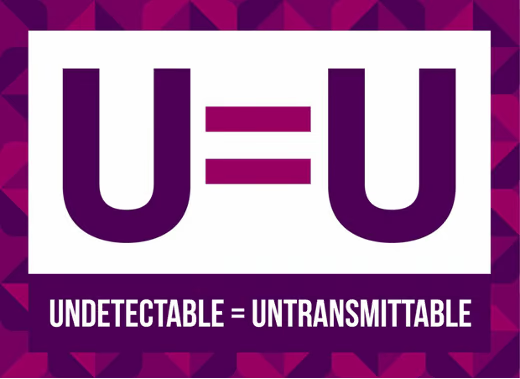
Inducible cell death (ICD): an innovative approach towards latency reversal and HIV cure in chronic HIV infected patients. (ICD-CHRONO study)
How can we cure over 40 million people living with HIV worldwide?
Finding a cure for HIV is essential to make this devastating disease history. Erasmus MC University Medical Center together with Gilead Sciences combine forces in the CHRONO project to discover new ways to cure HIV that will help ending the HIV epidemic.
The United Nations estimates that the HIV pandemic approaches over 40 million people and set the ambitious goal to end HIV/AIDS by 2030. Stigma still exists and without a cure, all people with HIV need therapy which puts huge logistical and financial burdens on often already vulnerable societies, apart from that this strategy is also associated with an ongoing risk of side-effects and viral resistance. Despite all preventive measures and one of the best care infrastructures in the world, the number of people living with HIV is also still increasing in the Netherlands. New ways to end HIV, in the Netherlands and worldwide, are urgently required.
The major obstacle to cure HIV is a persistent reservoir of virus in latent (sleeping) infected immune cells called memory CD4+T-cells. Here, HIV hides silently in our own genome when someone is on antiretroviral drugs, but will cause disease progression to AIDS once therapy is stopped. In the CHRONO project, we will selectively target the HIV reservoir of patients with HIV, by exploiting existing cellular pathways to induce reservoir cell death through innovative drug combinations that we identified. This is called shock&kill.
This study will be done with the help of people living with HIV and under care at Erasmus MC who will undergo leucapheresis. With the identification of a successful strategy to eradicate the reservoir, we can potentially resolve the HIV pandemic.
We have established a unique longitudinal cohort of People living with HIV-1 who started antiviral treatment during the chronic phase of infection, and we have characterized the decay dynamics of the reservoir longitudinally at the level of different molecular compartments using different state of the art technologies. In WP2, we have developed a specific and sensitive inducible reservoir quantitation technique, SQuHIVLa which we have successfully implemented and validated in studies conducted with actual patients, demonstrating the effectiveness and reliability of the technology in practical scenarios. As a result, the research has transitioned from the laboratory to real-world application, indicating a significant advancement towards practical implementation and eventual commercialization of the technology.
DisclaimerThis collaboration project is co-funded by the PPP Allowance made available by Health~Holland, Top Sector Life Sciences & Health, to EMC to stimulate public-private partnerships. For questions, please contact EMC directly via the following email address tki@erasmusmc.nl.
Other projects
In each PPP project, research institutions, businesses and healthcare organisations work together on a specific health challenge. Browse the full project overview.


Bekijk de programma’s
Binnen onze programma’s werken bedrijven, kennisinstellingen en regionale partners samen aan innovaties die bijdragen aan betere gezondheid en zorg.
Bekijk de partnerschappen
Strategische publiek-private partnerschappen (PPP's) zijn meerjarige samenwerkingen tussen bedrijven, kennisinstellingen en andere partijen.
Hoe kunnen we je helpen?
Heb je een vraag of wil je meer weten over Health Holland? We brengen je graag in contact met de juiste mensen, kennis en mogelijkheden om gezondheidsinnovatie te versnellen.
We have received your message
We will contact you within 3 to 4 working days. If your question is urgent, please contact us directly. Below is the contact option that best matches your subject.
Start again
Something went wrong while sending the form. Please try again.