Ex vivo drug testing for advanced bladder cancer to predict treatment efficacy: EVITA.
Fast and accurate testing to guide the selection of your customised treatment!
Erasmus MC and VitroScan leverage their expertise and technology to develop accurate testing using tumors derived from individual patients with bladder cancer. The project will deliver tools to assess the sensitivity of the patient’s tumor to chemotherapy before the therapy has actually started. The collaboration integrates leading scientific expertise and dedication to develop the tools for approved use in the clinic.
Bladder cancer is the 5th most common cancer in the Netherlands and it is potentially lethal with a mortality rate of 25 patients/week. Bladder cancer is sensitive to chemotherapy and patients receive chemotherapy before their bladder is surgically removed or to reduce the growth of metastases. However, the risk that bladder cancer is not sensitive to chemotherapy is >50%. As a result, many patients experience no benefit while they are being exposed to side-effects. Within this project, patient-specific tumor models are being developed to evaluate a patient’s tumor sensitivity to chemotherapy and thereby helping to guide treatment decisions.
To test drug sensitivity patterns of bladder cancer, a fast and accurate tumor testing platform will be established: the VitroScan test. The aim is to prove that the outcome of the VitroScan test correlates with the response to chemotherapy that has been observed in patients receiving chemotherapy. In parallel, the validated tumor testing tools will make further research possible to identify new drugs to expand the number of effective treatment options for bladder cancer patients.
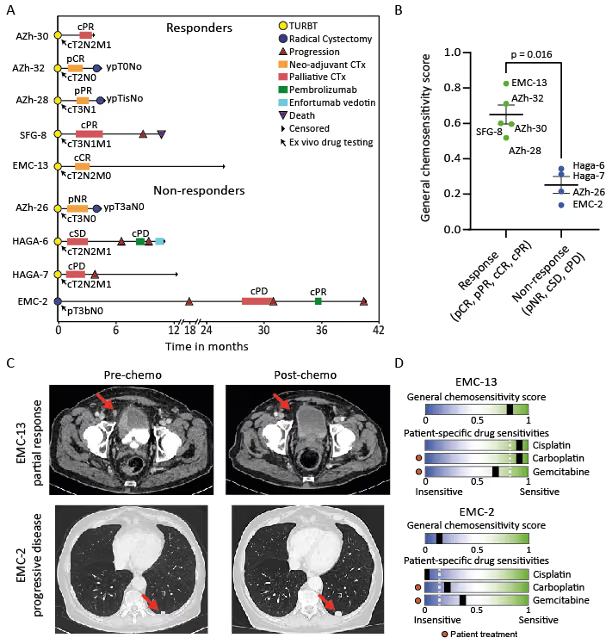
Deliverables of this project include the VitroScan test for bladder cancer and a substantial contribution to the Erasmus MC repository of bladder cancer organoids. Successful ex vivo drug testing in 48 of 65 bladder cancer patients (74%), with results obtained within 14 days of tissue collection. Ex vivo responses correlated with in-patient outcomes in 9 patients treated with platinum-based chemotherapy, as shown in Figure 1.
Figure 1. Ex vivo response to platinum-based chemotherapy correlates with patient response. A) Clinical course of muscle-invasive bladder cancer (MIBC) patients treated with platinum-based chemotherapy. B) Summary of general chemosensitivity score as determined through ex vivo 3D micro tumor testing, and matched clinical response to platinum-based chemotherapy according to pathological response group or RECIST 1.1 (mean±SEM; Mann-Whitney U). C) Clinical chemotherapy response according to RECIST 1.1 as illustrated by pre- and post-treatment computerized tomography scans from patient EMC-2. Red arrows indicate metastatic lesions. D) General chemosensitivity reporting, as illustrated for EMC-13 (sensitive) and EMC-2 (resistant). RECIST, Response Evaluation Criteria in Solid Tumors; CTx, Chemotherapy; cCR, clinical complete response; cPR, clinical partial response; cSD, clinical stable disease; cPD, clinical progressive disease; pCR, Pathological complete response; pPR, pathological partial response; pNR, pathological non-response; TURBT, Transurethral resection of the bladder tumor.
Other projects
In each PPP project, research institutions, businesses and healthcare organisations work together on a specific health challenge. Browse the full project overview.

Bekijk de programma’s
Binnen onze programma’s werken bedrijven, kennisinstellingen en regionale partners samen aan innovaties die bijdragen aan betere gezondheid en zorg.
Bekijk de partnerschappen
Strategische publiek-private partnerschappen (PPP's) zijn meerjarige samenwerkingen tussen bedrijven, kennisinstellingen en andere partijen.
Hoe kunnen we je helpen?
Heb je een vraag of wil je meer weten over Health Holland? We brengen je graag in contact met de juiste mensen, kennis en mogelijkheden om gezondheidsinnovatie te versnellen.
We have received your message
We will contact you within 3 to 4 working days. If your question is urgent, please contact us directly. Below is the contact option that best matches your subject.
Start again
Something went wrong while sending the form. Please try again.