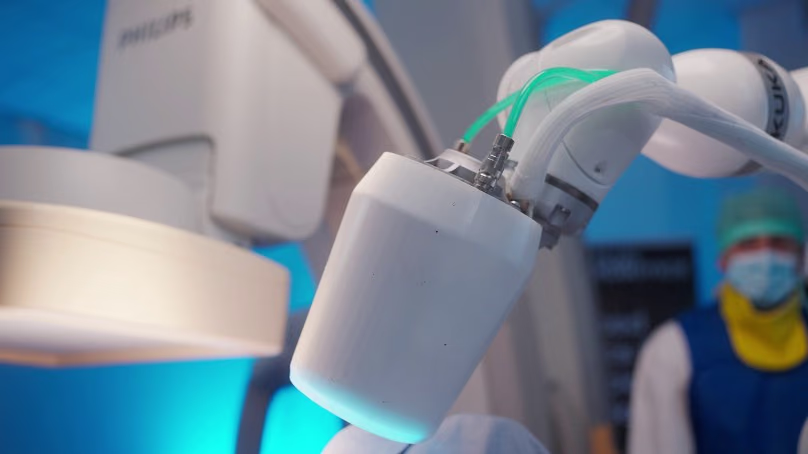
The Axiom System, an advanced, magnetically assisted solution for autonomous guidewire navigation
A breakthrough autonomous magnetic guidewire system enhancing precision, safety, and efficiency in vascular interventions
The University Medical Center Groningen (UMCG) and Flux Robotics have partnered to develop The Axiom System, an advanced, magnetically assisted guidewire navigation system for endovascular procedures. This public-private partnership aims to enhance the precision and safety of minimally invasive vascular treatments by introducing autonomous robotic control, reducing reliance on manual guidewire manipulation and X-ray imaging.
Cardiovascular diseases, including aortic aneurysms and peripheral arterial disease, are among the leading causes of mortality worldwide. In Europe alone, cardiovascular diseases account for 45% of all deaths, with treatment costs exceeding €210 billion annually. Endovascular interventions have significantly improved patient outcomes, but challenges remain, including high radiation exposure, kidney damage from contrast agents, and long procedure times. Innovative solutions like The Axiom System are crucial to improving efficiency, reducing healthcare costs, and enhancing patient safety.
The Axiom System employs a magnetically controlled robotic guidewire that autonomously navigates through blood vessels, eliminating the need for manual steering. By integrating advanced imaging and AI-driven path planning, the system minimizes radiation exposure, reduces the use of contrast agents, and improves procedural accuracy. This breakthrough technology represents a shift towards automation in endovascular interventions, enhancing both clinician workflow and patient outcomes.
The project will deliver a fully operational prototype, extensively tested in laboratory and preclinical settings. Expected outcomes include a 47% reduction in procedure times, an 80% decrease in radiation exposure, and improved success rates for complex vascular interventions. Upon successful validation, the system will advance towards clinical trials and eventual market adoption, paving the way for safer, more efficient vascular treatments worldwide.
Other projects
In each PPP project, research institutions, businesses and healthcare organisations work together on a specific health challenge. Browse the full project overview.

Bekijk de programma’s
Binnen onze programma’s werken bedrijven, kennisinstellingen en regionale partners samen aan innovaties die bijdragen aan betere gezondheid en zorg.
Bekijk de partnerschappen
Strategische publiek-private partnerschappen (PPP's) zijn meerjarige samenwerkingen tussen bedrijven, kennisinstellingen en andere partijen.
Hoe kunnen we je helpen?
Heb je een vraag of wil je meer weten over Health Holland? We brengen je graag in contact met de juiste mensen, kennis en mogelijkheden om gezondheidsinnovatie te versnellen.
We have received your message
We will contact you within 3 to 4 working days. If your question is urgent, please contact us directly. Below is the contact option that best matches your subject.
Start again
Something went wrong while sending the form. Please try again.