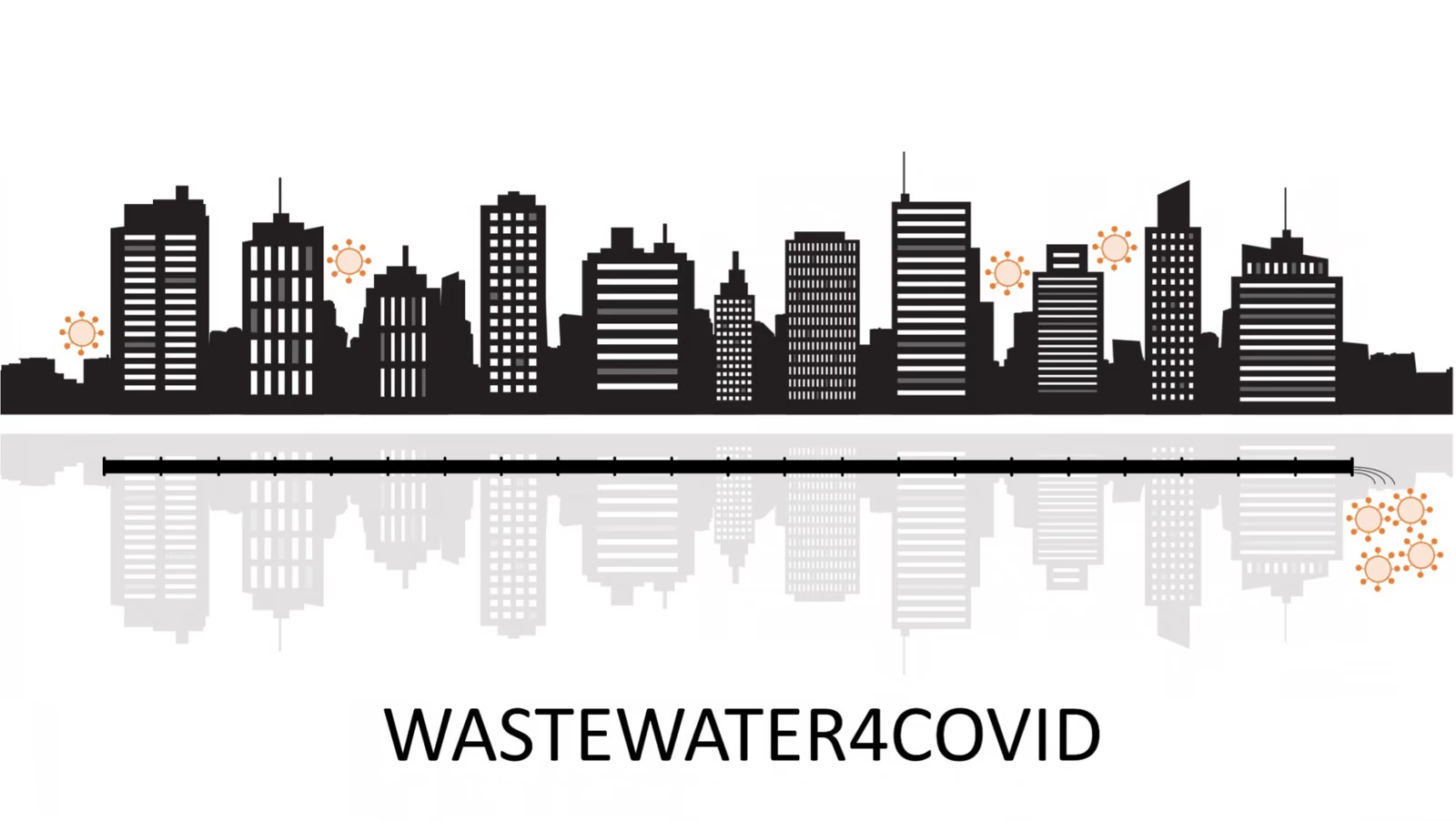
Wastewater monitoring of SARS-CoV-2 RNA loads to provides reliable information about the trends of the circulation of COVID-19 infections (and others) in the population
WW4Covid helped provide the proof-of-concept and added public health value of wastewater surveillance of COVID-19
Wastewater4Covid helped to provide the proof-of-concept and added public health value of wastewater surveillance of COVID-19 in different contexts. Wastewater4COVID was awarded the EUREKA status under the EUREKA COVID-19 Network Call: Solutions for COVID-19 Echo Period “Life without a vaccine”. This resulted in a joint project with parallel Dutch and South African research partners and activities. The PPP allowance from Health~Holland was used for the Dutch part of the project in a new collaboration between KWR Water Research Institute, Royal HaskoningDHV and Waternet. The South African part was funded through the Department of Science and Technology with the consortium partners Waterlab, in collaboration with the University of Pretoria and Royal HaskoningDHV South Africa.
Wastewater4Covid demonstrated that wastewater monitoring of SARS-CoV-2 loads provides reliable information about the trends of the circulation of infections in the population. The added value of wastewater surveillance is early warning in advance of clinical testing data. A related advantage is that wastewater surveillance includes all infections in the community, including asymptomatic or mildly symptomatic infections, and is unbiased by testing behaviour and availability. It is an agile population surveillance tool that can be deployed at different scales, with a single sample representing a city or city area. Similar protocols work equally well in sewered cities/areas in South Africa as in the Netherlands. This is relevant for large parts of the global community, as only 50% of the global population is connected to a sewer network. We demonstrated that wastewater surveillance can be cost-effective and can detect the emergence of new variants of concern, at much lower cost (or with much higher granularity) than clinical surveillance.
The data were communicated with the respective Municipal Health Services and Outbreak Management Teams, where they were compared with other surveillance data, and recognized as relatively unbiased sources of virus circulation.
Andere projecten
In elk PPS-project werken kennisinstellingen, bedrijven en zorgpartijen samen aan een concrete gezondheidsvraag. Bekijk het volledige projectoverzicht.
Bekijk de programma’s
Binnen onze programma’s werken bedrijven, kennisinstellingen en regionale partners samen aan innovaties die bijdragen aan betere gezondheid en zorg.
Bekijk de partnerschappen
Strategische publiek-private partnerschappen (PPP's) zijn meerjarige samenwerkingen tussen bedrijven, kennisinstellingen en andere partijen.
Hoe kunnen we je helpen?
Heb je een vraag of wil je meer weten over Health Holland? We brengen je graag in contact met de juiste mensen, kennis en mogelijkheden om gezondheidsinnovatie te versnellen.
We hebben uw bericht ontvangen
We nemen binnen 3 tot 4 werkdagen contact met je op. Is je vraag dringend? Neem dan gerust direct contact met ons op. Hieronder zie je de contactoptie die het beste past bij je onderwerp.
Opnieuw beginnen
Er ging iets mis bij het versturen van het formulier. Probeer het opnieuw.