Ultra-fast and strong gradient diffusion MRI for improved characterization of microstructural changes in Alzheimer’s and Small Vessel Disease leading to dementia
MicroScan will development MRI markers sensitive to tissue compartments that are “off-limits” with conventional MRI
With the increasingly ageing population, cognitive decline and dementia have an enormous impact on society, with Alzheimer's disease (AD) and small vessel disease (SVD) being the two leading causes. There is a desperate need for sensitive and specific disease markers associated with clinical deficits for improved disease monitoring and understanding of the underlying pathology.
The last decades have witnessed a quantum leap in noninvasive quantitative characterization of brain tissue microstructure using magnetic resonance imaging (MRI). Especially, the advent of strong and fast imaging gradient setups can provide the instrument to tremendously improve the sensitivity and specificity of microstructural measurements. While promising, strong-gradient imaging requires bulky (expensive) setups and causes painful acoustic noise, and has thus only scarcely been applied in patients.
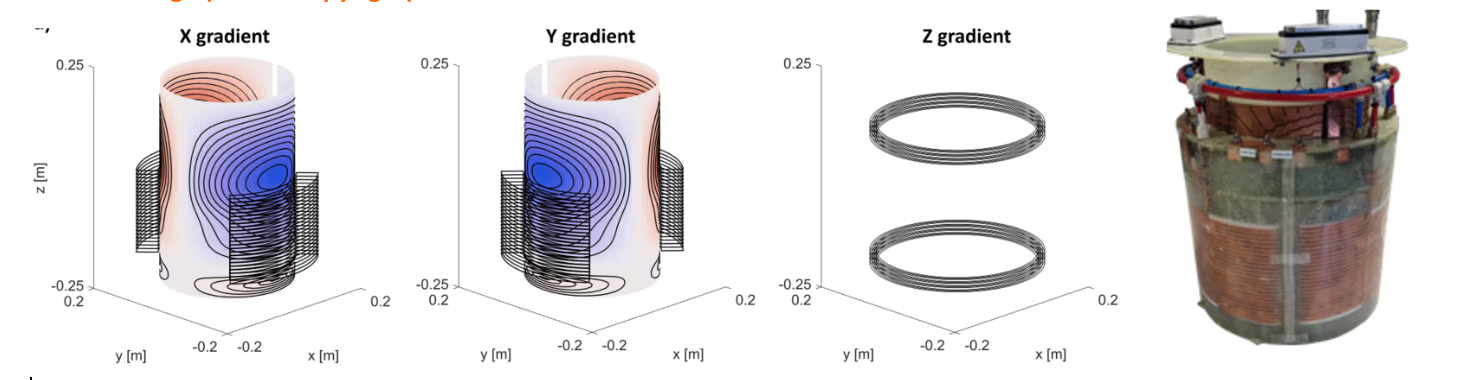
In this proposal, we aim for unprecedented characterization of microstructural changes related to AD and SVD in a patient-friendly way. The project's partnership between UMC Utrecht and Tesls DC will develop and evaluate a novel lightweight, silent head imaging setup with ultra-fast (>20 kHz) strong gradients for dedicated microstructural imaging.
We will assess its user-friendliness and evaluate MRI markers with increased specificity for microstructural changes in patients with AD and SVD. We will assess the feasibility of obtaining novel MRI proxies of myelin integrity with this setup to acquire new knowledge of the underlying microstructural changes in AD and SVD. It is expected that this will provide the imaging tools to elucidate the pathophysiology leading to dementia and monitor future treatment effects at the tissue level.
This project brought together a successful public–private partnership to develop and evaluate new MRI technology for more precise and comfortable brain imaging. By combining academic expertise in neuroimaging with industrial know-how in gradient hardware, the team created and tested innovative MRI setups designed to improve the diagnosis and understanding of dementia, in particular Alzheimer’s disease (AD) and small vessel disease (SVD).
Dementia is a growing global health challenge, currently affecting over 55 million people worldwide and expected to rise to 78 million by 2030. AD and SVD are the leading causes, together accounting for most dementia cases. Early detection is critical but remains difficult, as existing MRI methods often lack the sensitivity to detect the subtle tissue changes that occur before cognitive symptoms appear. New imaging technologies are urgently needed to enable earlier diagnosis, better monitoring, and to support treatment development for ageing populations.
To address these challenges, the project developed advanced diffusion MRI (dMRI) protocols and strong, silent gradient hardware to achieve faster and more detailed brain imaging. A single-axis gradient insert was evaluated, demonstrating a substantial increase in image quality while remaining safe and comfortable for volunteers. Based on this experience, a 3-axis gradient coil was developed, enabling microstructural imaging in all directions to better capture the complex tissue organization of the brain.
The project successfully demonstrated the feasibility and reproducibility of high-performance diffusion MRI using these new technologies. The findings confirm the potential of this innovation to make MRI scanning faster, quieter, and more informative—laying the groundwork for future clinical translation and improved diagnosis of dementia and other brain diseases.
Andere projecten
In elk PPS-project werken kennisinstellingen, bedrijven en zorgpartijen samen aan een concrete gezondheidsvraag. Bekijk het volledige projectoverzicht.
Bekijk de programma’s
Binnen onze programma’s werken bedrijven, kennisinstellingen en regionale partners samen aan innovaties die bijdragen aan betere gezondheid en zorg.
Bekijk de partnerschappen
Strategische publiek-private partnerschappen (PPP's) zijn meerjarige samenwerkingen tussen bedrijven, kennisinstellingen en andere partijen.
Hoe kunnen we je helpen?
Heb je een vraag of wil je meer weten over Health Holland? We brengen je graag in contact met de juiste mensen, kennis en mogelijkheden om gezondheidsinnovatie te versnellen.
We hebben uw bericht ontvangen
We nemen binnen 3 tot 4 werkdagen contact met je op. Is je vraag dringend? Neem dan gerust direct contact met ons op. Hieronder zie je de contactoptie die het beste past bij je onderwerp.
Opnieuw beginnen
Er ging iets mis bij het versturen van het formulier. Probeer het opnieuw.