A 3-dimensional co-culture model of human liver tumor organoids and tumor-infiltrating lymphocytes to test immunotherapeutic antibodies
3-D Co-cultures facilitate screening of immunotherapeutic drugs for their ability to enhance tumor-directed immune responses
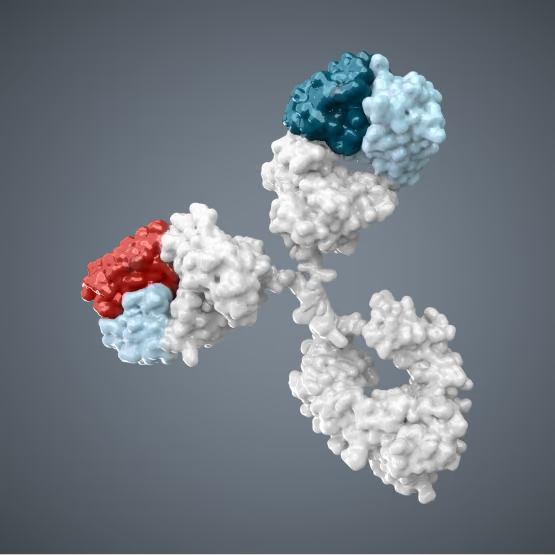
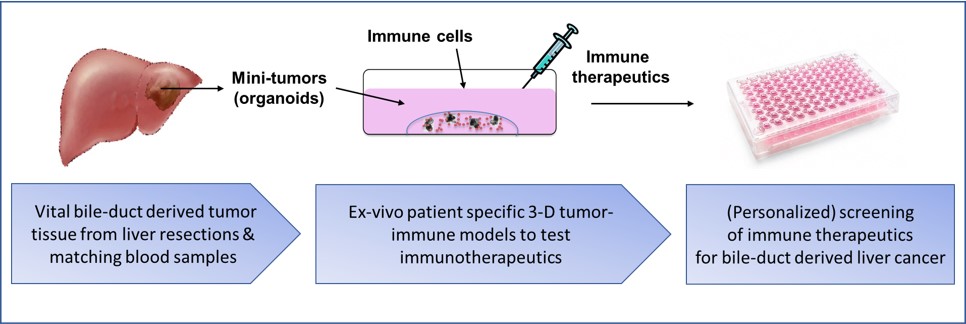
Erasmus MC-University Medical Centre (Rotterdam) and Merus NV, a clinical-stage biotechnological company in Utrecht have developed a novel technique to culture three-dimensional mini-tumors, that are grown from surgically resected human liver tumors derived from bile duct cells (cholangiocarcinoma; CCA) with immune cells from the same patient. Merus NV is a company focused on the development of Biclonics® antibodies to treat cancer. Merus NV has developed full length, IgG bispecific immune checkpoint antibody candidates (Biclonics®) that have the potential to be more effective compared to conventional mono-specific antibodies potentially mitigating immune-related toxicity.
Because liver-cancer derived from bile-ducts is not as prevalent as the more common liver cell derived form (hepatocellular carcinoma; HCC) much less is known about the effectiveness of immunotherapeutic drugs. Furthermore, the poor prognosis/survival of patients makes clinical research very challenging. Thus created co-culture system represent a great opportunity to now assess drug candidates in a relevant system and without animal models.
At Erasmus MC mini-tumor-immune co-cultures were derived from bile-duct derived liver tumor which were then co-cultured with immune cells derived from the same patient to mimic the intro-tumor micro-environment. In this environment immune suppressive mechanisms are at play that counteract tumor immune clearance. These suppressive mechanisms are targets of many immune therapeutics including the Biclonics® generated by Merus NV.
The mini-tumor-immune co-cultures developed in this partnership are now used to screen for the effectiveness of immunotherapeutics in bile-duct derived liver cancer. Moreover, co-cultures of tumor and tumor-reactive immune cells may be further developed as a tool for treatment decision to test efficacy of a number of drugs in vitro prior to administration in a patient personalised setting. This could not only help to select the best drug but also may prevent overtreatment and hence unnecessary costs and side-effects.
More information can be found here.
Andere projecten
In elk PPS-project werken kennisinstellingen, bedrijven en zorgpartijen samen aan een concrete gezondheidsvraag. Bekijk het volledige projectoverzicht.

Bekijk de programma’s
Binnen onze programma’s werken bedrijven, kennisinstellingen en regionale partners samen aan innovaties die bijdragen aan betere gezondheid en zorg.
Bekijk de partnerschappen
Strategische publiek-private partnerschappen (PPP's) zijn meerjarige samenwerkingen tussen bedrijven, kennisinstellingen en andere partijen.
Hoe kunnen we je helpen?
Heb je een vraag of wil je meer weten over Health Holland? We brengen je graag in contact met de juiste mensen, kennis en mogelijkheden om gezondheidsinnovatie te versnellen.
We hebben uw bericht ontvangen
We nemen binnen 3 tot 4 werkdagen contact met je op. Is je vraag dringend? Neem dan gerust direct contact met ons op. Hieronder zie je de contactoptie die het beste past bij je onderwerp.
Opnieuw beginnen
Er ging iets mis bij het versturen van het formulier. Probeer het opnieuw.