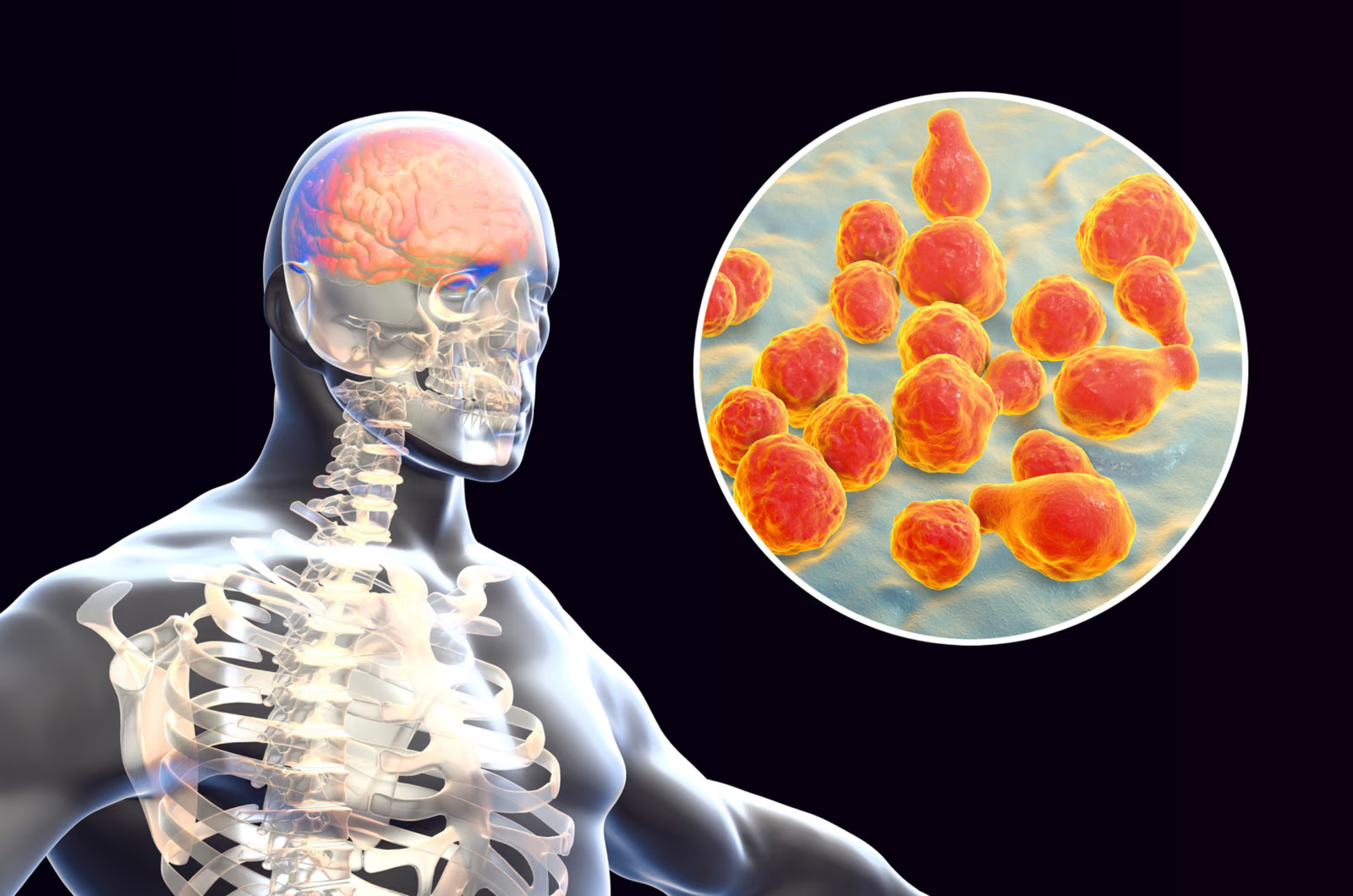
Mechanism of complement activation and amplification in bacterial meningitis
This project investigates mechanisms of complement activation in bacterial meningitis aiming for new treatment targets for patients with this devastating disease
Bacterial meningitis is a severe infection of the central nervous system. During bacterial meningitis an uncontrolled, massive inflammatory response occurs, causing brain damage and death. InflaRX, the industrial consortium partner, has developed a monoclonal antibody (IFX-1) against complement component 5a (C5a), which is currently the most promising treatment target in bacterial meningitis. This treatment was shown to be safe and effective in inhibiting the complement system in humans. Both applicant and InflaRX aim to work towards a phase-2b clinical trial in bacterial meningitis patients. Before this trial can be initiated questions regarding the underlying mechanisms, safety, and necessary treatment duration need to be answered. The objective is to confirm the potential of C5a-antibody therapy in bacterial meningitis patients by using human samples both in vitro and in vivo. In work package 1, we will study the dynamics of complement activation in blood and cerebrospinal fluid of acute bacterial meningitis patients to elucidate the duration and mechanisms of complement activation. For this, we will measure complement components and other markers of infection in serial blood samples and cerebrospinal fluid from the diagnostic lumbar puncture in bacterial meningitis patients. In work package 2, we will setup an in vitro whole blood killing assay in which we can study the effect of complement inhibition on bacterial outgrowth and the inflammatory response. This model will allow us to simulate different treatment conditions (e.g. antibiotics and dexamethasone) for the major pathogens causing bacterial meningitis (Streptococcus pneumoniae, Neisseria meningitidis, and Listeria monocytogenes). This will help to define whether C5a-antibodies can be safely administered to all suspected bacterial meningitis patients irrespective of the causative pathogen. Our project presents an essential step in designing a randomized controlled trial of C5a-antibody treatment in patients with bacterial meningitis.
Fourth paragraph:
*Description of Deliverables
Work Package 1: Analysis of Complement Activation and Immune Response in Patients with Bacterial Meningitis
1. ELISA and Luminex Pilots in Blood Samples / Protocols: Development and validation of protocols for measuring complement components and cytokines/chemokines in blood and cerebrospinal fluid (CSF) using ELISA and Luminex technology.
2. ELISA and Luminex Pilots in CSF Samples / Protocols: Development of measurement protocols specifically for complement components in CSF samples.
3. Final Inclusion / 100th Inclusion: Recruitment and analysis of blood and CSF samples from 100 patients with bacterial meningitis.
4. Final ELISA and/or Luminex Analyses: Completion of measurements of complement components and immune markers in all collected samples.
5. Final Product / Completed Manuscript(s):
a. Koelman DLH,Brouwer MC, van de Beek D. Targeting the complement system in bacterial meningitis. Brain 2019; 142; 3335-3337.
b. Kasanmoentalib ES, Valls Serón M, Engelen-Lee JY, Tanck MW, Pouw RB, van Mierlo G, Wouters D, Pickering MC, van der Ende A, Kuijpers TW, Brouwer MC, van de Beek D. Complement factor H contributes to mortality in humans and mice with bacterial meningitis. J Neuroinflammation 2019; 16: 279.
c. Dias SP, Brouwer MC, Boelen A, van de Beek D. Cerebrospinal fluid sex steroid hormones in bacterial meningitis. Medicine 2022; 101: e30452.
d. Chekrouni N, van Soest TM, da Cruz Campos AC, Brouwer MC, van de Beek D. Bacterial load in cerebrospinal fluid predicts unfavourable outcome in pneumococcal meningitis: a prospective nationwide cohort study. Clin Microb Infect 2024; 30: 772-774.
Work Package 2: In Vitro Research on the Effects of Complement Inhibition on Bacterial Growth and Immune Response
1. First Experiments with Different Pathogens / Growth Curves: Establishment of growth curves for pathogens such as Streptococcus pneumoniae and Neisseria meningitidis.
2. First Whole Blood Killing (WBK) Experiments / Protocol: Development and validation of a protocol for the whole blood killing assay to study bacterial survival in human blood.
3. Intervention Studies in WBK Assay / Dose-Response Curves: Investigation of the dose dependency of C5 and C5a inhibition and its effect on bacterial survival.
4. Drug Studies: Evaluation of the effectiveness of C5 inhibitor Eculizumab (Soliris) and C5a inhibitor IFX-1 (vilobelimab) on inhibiting bacterial growth in the whole blood killing assay.
5. Experiments with Larger Groups of Volunteers: Extension of WBK experiments to multiple volunteers to evaluate variability and confirm results.
These deliverables are central to the project’s objectives and execution. They have contributed to the scientific results and technological progress required for future clinical studies involving complement inhibitors in bacterial meningitis.
Illustration end-results
The key results of this project are clinical data on 98 patients with bacterial meningitis which showed Elevated levels of complement components C3a, C5a, and C5b-9 during acute disease. We also found higher C5a levels correlated with poor outcomes in patients. Other end results are laboratory data showing that Neisseria meningitidis survival increased with C5 inhibition, but not with C5a inhibition. In conclusion, the results show that inhibition of complement component C5a is a safe and potentially effective treatment in patients with bacterial meningitis. Next potential steps is a Phase 2B clinical trial for vilobelimab (anti-C5a) in bacterial meningitis.
Andere projecten
In elk PPS-project werken kennisinstellingen, bedrijven en zorgpartijen samen aan een concrete gezondheidsvraag. Bekijk het volledige projectoverzicht.

Bekijk de programma’s
Binnen onze programma’s werken bedrijven, kennisinstellingen en regionale partners samen aan innovaties die bijdragen aan betere gezondheid en zorg.
Bekijk de partnerschappen
Strategische publiek-private partnerschappen (PPP's) zijn meerjarige samenwerkingen tussen bedrijven, kennisinstellingen en andere partijen.
Hoe kunnen we je helpen?
Heb je een vraag of wil je meer weten over Health Holland? We brengen je graag in contact met de juiste mensen, kennis en mogelijkheden om gezondheidsinnovatie te versnellen.
We hebben uw bericht ontvangen
We nemen binnen 3 tot 4 werkdagen contact met je op. Is je vraag dringend? Neem dan gerust direct contact met ons op. Hieronder zie je de contactoptie die het beste past bij je onderwerp.
Opnieuw beginnen
Er ging iets mis bij het versturen van het formulier. Probeer het opnieuw.