
Development of a Steep Ramp Test toolkit for easy and standardised assessment of cardiorespiratory fitness
Easy cardiorespiratory fitness assessment in clinical practice: a Steep Ramp Test toolkit and norm values
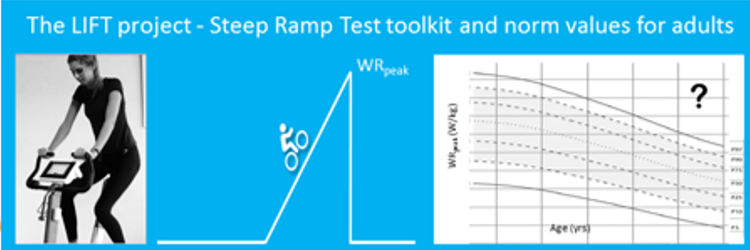
To facilitate an easy assessment of cardiorespiratory fitness (CRF), the LIfelong Fitness Testing (LIFT) project aims to develop a feasible toolkit for standardised Steep Ramp Test (SRT) assessment and interpretation in daily (clinical) practice and research. Partners in this public private partnership consist of public partners with extensive experience in CRF assessment and a private partner with extensive expertise in marketing and development of medical devices.
Although CRF is being recognised as an important marker of health and functioning, it is currently not routinely assessed in daily (clinical) practice. There is an urgent need for a simple and feasible exercise test that can validly and reliably estimate an individual’s CRF. The SRT is such a practical short-time exercise test on a cycle ergometer. Although the SRT is already frequently used in the Netherlands, norm values for adults and elderly are lacking, which limits interpretation of test results. Furthermore, health care professionals all developed their own routines in executing the SRT.
The project objectives are 1) collecting an adequate set of representative sex- and age-specific norm values for SRT performance in healthy adults, including elderly, 2) investigating the clinimetrics (criterion validity and test-retest reliability) of the SRT in this population, 3) examining the physiological responses during SRT performance, and 4) developing a feasible toolkit for standardised SRT assessment and interpretation.
The availability of norm values for adults and elderly will significantly improve the applicability of the SRT and allow for frequent CRF estimation in daily (clinical) practice. The toolkit for standardised SRT assessment and interpretation will create opportunities for frequent monitoring of CRF in large populations, in all kinds of settings. Increasing knowledge regarding the physiological response to SRT performance is essential to better understand and interpret test results and justify its use in both scientific research and daily (clinical) practice.
Andere projecten
In elk PPS-project werken kennisinstellingen, bedrijven en zorgpartijen samen aan een concrete gezondheidsvraag. Bekijk het volledige projectoverzicht.
Bekijk de programma’s
Binnen onze programma’s werken bedrijven, kennisinstellingen en regionale partners samen aan innovaties die bijdragen aan betere gezondheid en zorg.
Bekijk de partnerschappen
Strategische publiek-private partnerschappen (PPP's) zijn meerjarige samenwerkingen tussen bedrijven, kennisinstellingen en andere partijen.
Hoe kunnen we je helpen?
Heb je een vraag of wil je meer weten over Health Holland? We brengen je graag in contact met de juiste mensen, kennis en mogelijkheden om gezondheidsinnovatie te versnellen.
We hebben uw bericht ontvangen
We nemen binnen 3 tot 4 werkdagen contact met je op. Is je vraag dringend? Neem dan gerust direct contact met ons op. Hieronder zie je de contactoptie die het beste past bij je onderwerp.
Opnieuw beginnen
Er ging iets mis bij het versturen van het formulier. Probeer het opnieuw.