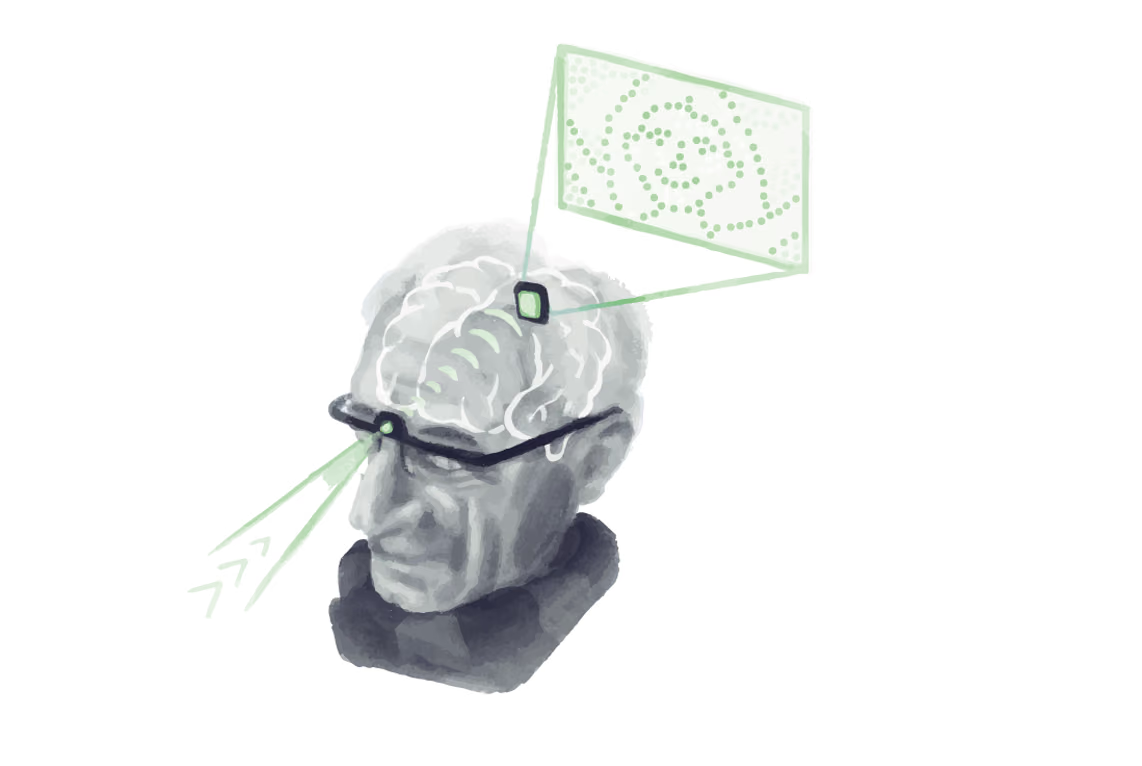
A prosthesis to restore vision in the blind
The project POSITIONED develops a new probe to restore vision for blind people
The public summary consists of 250 to max. 300 words. The summary is intended for a broad audience with a secondary education language level. In short, the public summary describes the who, what, where, when, why and how of the project. Focus on the core message of the project instead of elaborating on explanations and background information.
The project POSITIONED is a collaboration between the Netherlands Institute for Neuroscience and the company Phosphoenix aiming to develop a new probe that can be inserted in the brain to restore a rudimentary form of vision for blind people. The new technology will thereby connect a camera to the visual brain of the blind user, bypassing the malfunctioning eyes. The approach may provide a solution for a large fraction of the people who are blind, a condition that affects more than 40 million people across the world. More than half of them cannot benefit from treatments of the eye because the connections between eye and brain degenerated. These patients can therefore only benefit from a visual brain prosthesis, which would increase their independence by allowing them to engage in activities for which they now rely on caregivers. POSITIONED will develop a probe to stimulate brain cells electrically, creating a brain interface that enables artificial perception in the entire visual field and that can work for many years, something that has not been achieved with previous approaches. The future user will wear a camera, and the video stream is processed to give rise to the artificial perceptions outlining the relevant objects in the user’s vicinity. POSITIONED will test the new probe in mice to assess its functionality, how well it integrates with the brain tissue and how long it keeps working, as in important step towards validation in the clinic. At the end of the project, the researchers will have gained important new insights into the response of the brain to the new probe and how well the electrical activation of brain cells leads to visual perception.
The POSITIONED project developed an innovative brain implant called the fountain probe to restore rudimentary vision in blind individuals. The project brought together the Netherlands Institute for Neuroscience (KNAW) and Phosphoenix B.V. in a strong public–private partnership, combining complementary expertise in neuroscience, engineering, and microfabrication. Together, the partners successfully designed, produced, and tested a prototype implant capable of reaching deep visual brain regions through a minimally invasive procedure.
Globally, more than 40 million people are blind, and for many of them, conventional eye treatments are ineffective because of irreversible damage to the retina or optic nerve. This loss of vision severely affects independence, employment, and quality of life, leading to significant personal and societal costs. Innovation in brain-based prostheses is therefore crucial. Developing a safe and effective implant that bypasses the damaged visual system could restore basic visual perception and strengthen Europe’s leadership in the fast-growing neurotechnology sector.
The project focused on the development of the fountain probe, a flexible, high-density array of microscopic electrodes designed to stimulate the lateral geniculate nucleus (LGN), a key relay station in the visual pathway. The team first conceptualised and optimised the design, increasing the number of electrodes for higher resolution. The probe’s deployment mechanics were tested, followed by neurophysiological experiments to assess performance in living brain tissue, ensuring minimal damage and long-term stability.
The implant performed safely and reliably in vivo, evoking expected visual responses while causing less tissue reaction than traditional silicon electrodes. Its stable operation over several months showed that the technology functions as intended, although long-term effects still need to be evaluated. The project delivered a robust scientific and technical foundation for future prostheses that may one day restore vision to blind individuals.
Andere projecten
In elk PPS-project werken kennisinstellingen, bedrijven en zorgpartijen samen aan een concrete gezondheidsvraag. Bekijk het volledige projectoverzicht.
Bekijk de programma’s
Binnen onze programma’s werken bedrijven, kennisinstellingen en regionale partners samen aan innovaties die bijdragen aan betere gezondheid en zorg.
Bekijk de partnerschappen
Strategische publiek-private partnerschappen (PPP's) zijn meerjarige samenwerkingen tussen bedrijven, kennisinstellingen en andere partijen.
Hoe kunnen we je helpen?
Heb je een vraag of wil je meer weten over Health Holland? We brengen je graag in contact met de juiste mensen, kennis en mogelijkheden om gezondheidsinnovatie te versnellen.
We hebben uw bericht ontvangen
We nemen binnen 3 tot 4 werkdagen contact met je op. Is je vraag dringend? Neem dan gerust direct contact met ons op. Hieronder zie je de contactoptie die het beste past bij je onderwerp.
Opnieuw beginnen
Er ging iets mis bij het versturen van het formulier. Probeer het opnieuw.