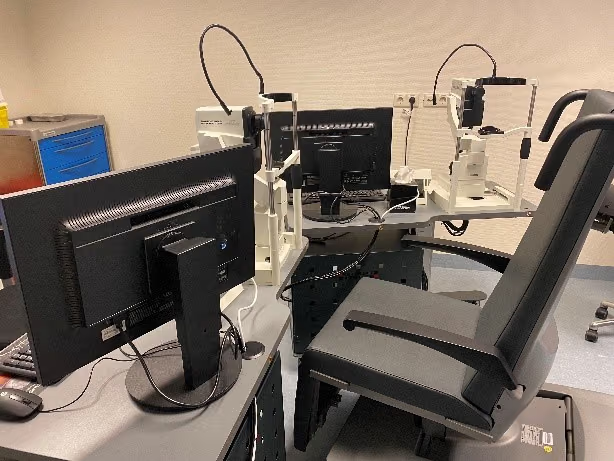
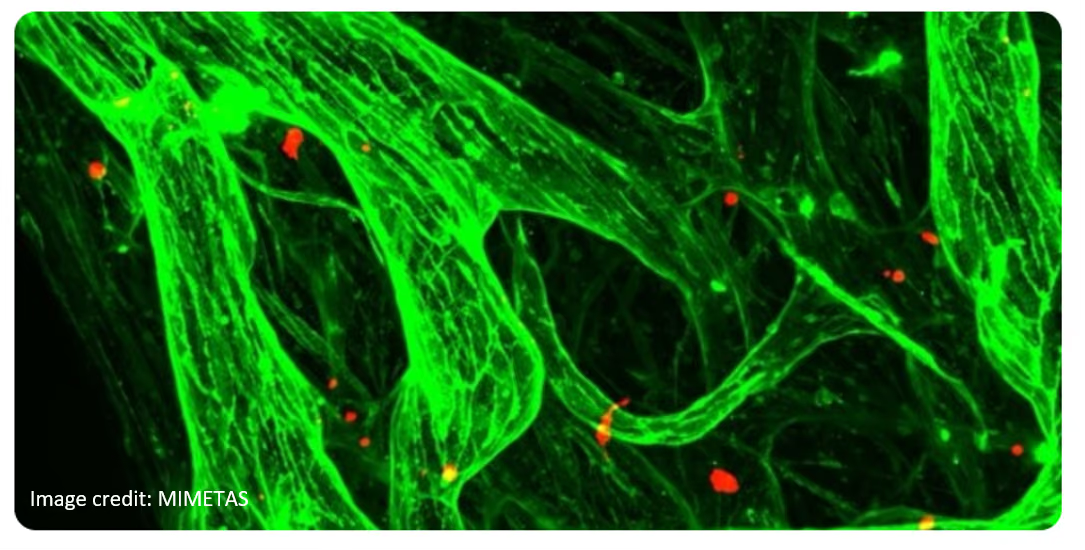
Targeted fluorescence imaging using in neovascular Age-related Macular Degeneration patients to evaluate the upregulation of vascular endothelial growth factor, and in inflammatory bowel disease and rheumatoid arthritis to evaluate the drug distribution.
Fluorescent imaging of vascularisation and drug distribution with a fluorescent tracer: safe and feasible?
The performance of intravitreal distribution of fluorescent anti-VEGF-A in the eye will be tracked to provide information about neovascularisation and inflammation in neovascular Age-Related Macular Degeneration (AMD). They will also assess the performance of fluorescent anti-TNFa in inflammatory bowel disease (IBD) and rheumatoid arthritis (RA). The found information can subsequently be used for drug development programs. During this project they will collaborate with Tracer, a company specialised in first-in-human studies with the use of nuclear and optical imaging techniques.
IBD and RA are auto-immune diseases which are characterised by chronic inflammation in the bowel or in joints. Pathogenesis of both auto-immune diseases is attributed to the factor TNFa. To treat IBD and RA adalimumab, an anti-TNFa medicine, can be used. However, current rates of non-responsiveness to this medicine are difficult to predict in advance, meaning patients may be exposed to a non-effective treatment and its potential side effects; while clinical deterioration progresses. Unfortunately, crucial information about drug distribution of the drug of interest is lacking. Therefore, it remains unknown in both IBD and RA, if the drug reaches its target. Thus, this project linked adalimumab to a fluorescent dye (adalimumab-800CW) in order to create a fluorescence signal of the labelled drug in the diseased tissue that they can visualise and quantify with dedicated optical fluorescence imaging systems.
In the opthamology study it is aimed to visualise the upregulation of VEGF in AMD using a VEGF-A-targeting medicine (Bevacizumab). Hereby they can demonstrate the specific uptake of bevacizumab in patients compared to a comparable fluorescent antibody which will not be present in the eye. Ultimately, VEGF imaging can act as a proof of concept, and pave the way for broad application to track performance of drugs by fluorescence molecular imaging.
Read more on this website.
Andere projecten
In elk PPS-project werken kennisinstellingen, bedrijven en zorgpartijen samen aan een concrete gezondheidsvraag. Bekijk het volledige projectoverzicht.


Bekijk de programma’s
Binnen onze programma’s werken bedrijven, kennisinstellingen en regionale partners samen aan innovaties die bijdragen aan betere gezondheid en zorg.
Bekijk de partnerschappen
Strategische publiek-private partnerschappen (PPP's) zijn meerjarige samenwerkingen tussen bedrijven, kennisinstellingen en andere partijen.
Hoe kunnen we je helpen?
Heb je een vraag of wil je meer weten over Health Holland? We brengen je graag in contact met de juiste mensen, kennis en mogelijkheden om gezondheidsinnovatie te versnellen.
We hebben uw bericht ontvangen
We nemen binnen 3 tot 4 werkdagen contact met je op. Is je vraag dringend? Neem dan gerust direct contact met ons op. Hieronder zie je de contactoptie die het beste past bij je onderwerp.
Opnieuw beginnen
Er ging iets mis bij het versturen van het formulier. Probeer het opnieuw.