Creating a low-risk strategy for rapid and efficient engraftment after hematopoietic stem cell transplantation
We will develop non-toxic protocols for bone marrow conditioning prior to hematopoietic stem cell transplantation
Hematopoietic stem cell transplantation (HSCT), to treat inherited blood diseases such as sickle cell anaemia and primary immunodeficiencies including X-linked severe combined immunodeficiency (SCID) and malignant disease including myeloid dysplastic syndromes and acute myeloid leukemia, has proven to be effective for the treatment of hematopoietic disorders. However, current preparation for HSCT carries significant toxicity due to radiation or chemotherapy that put the patient, often at very young age and/or weak condition, at high risk of life-threatening infections and toxicity. Therefore, Erasmus MC and Harbour Biomed have developed a low-risk solution by engineering and pre-clinically testing of novel antibody reagents that rapidly and transiently prepare the bone marrow for HSCT without toxicity.
Our improved HSCT protocol will ultimately enhance the quality of life of a large group of benign and malignant patients in need for HSCT. This novel approach will enable the upcoming clinically safe genome editing tools that are currently in development for the generation of genetically corrected autologous hematopoietic stem cells successful. In 2030, the share of people with a chronic illness that prefers to participate in society is increased by 25%. In addition, the life-long health care cost for primary immunodeficiency patients has been estimated to be $55,000/year. Developing a safe method for corrective autologous HSCT is expected to significantly reduce these costs and greatly reduce comorbidities. Because of reduced hospitalizations patients will be able to attend school and work. Thus health-related productivity losses would be greatly reduced.
We successfully developed, optimized novel antibodies and improved bone marrow conditioning prior to HSCT without detectable toxicity. Our novel antibody reagents were thoroughly tested in our laboratories for proper functionality in pre-clinical humanized mouse models. Our data is the basis for a patent owned by Erasmus MC and Harbour Biomed.
Deliverables
We have generated an optimal low-risk bi-specific antibody reagent (PR004384-CD117xCD3 BiTE) for bone marrow conditioning prior to HSCT that allows hematopoietic stem cell transplantation (see Figure 1).
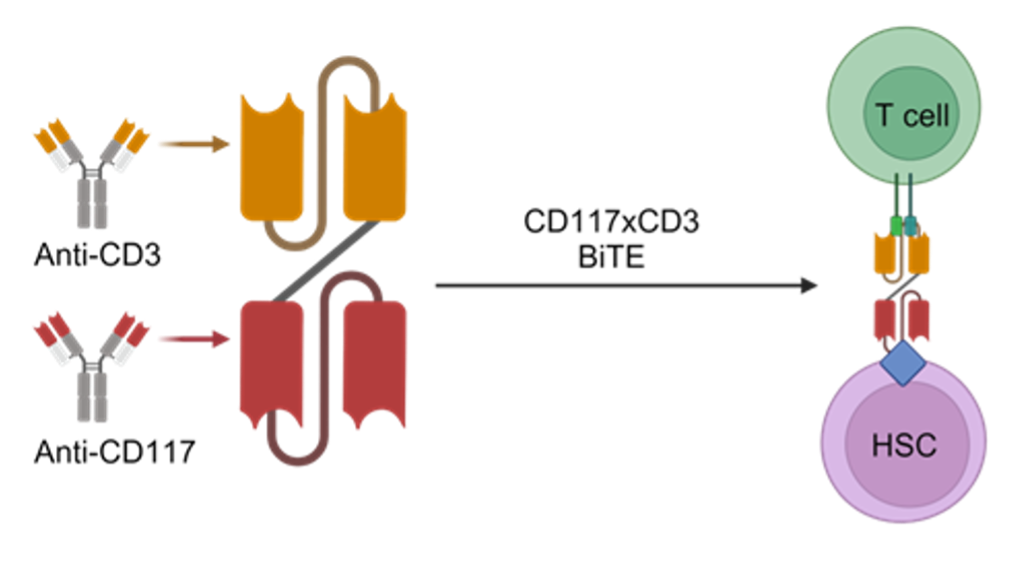
Figure 1: Illustration of end result. Schematic overview of our PR004384-CD117xCD3 Bispecific T cell engager (BiTE)
PR004384 reagent consists of an anti-CD3 and an anti-CD117 part. This PR004384-CD117xCD3 BiTE brings T cells in direct contact to hematopoietic stem cells (HSC). This BiTE-mediated interaction of the T cell with HSC causes activation of the T cell and killing of HSC.
Description of end result:
We successfully generated 10 novel antibodies to deplete hematopoietic stem cells and their controls, of which PR004384-CD117xCD3 BiTE was the most successful. We observed a 95% depletion of human hematopoietic stem cells in the BM of PR004384-CD117xCD3 BiTE-treated mice at 16 hours post-treatment and an almost full depletion of hematopoietic stem cells at 5 days post-treatment. In addition, we established that in vivo the PR004384 has a short serum half-life (T½-value) of 2 hours and 19 minutes, allowing for precision therapy. No obvious toxicity has been observed in PR004384-treated humanized mice. PR004384-CD117xCD3 BiTE-treatment allowed successful hematopoietic stem cell transplantation in pre-clinical humanized mouse models. Next, pre-clinical studies in rhesus macaque will be initiated in the coming year. When successful, PR004384 is a very promising reagent for initiating phase-I clinical trials in the future.
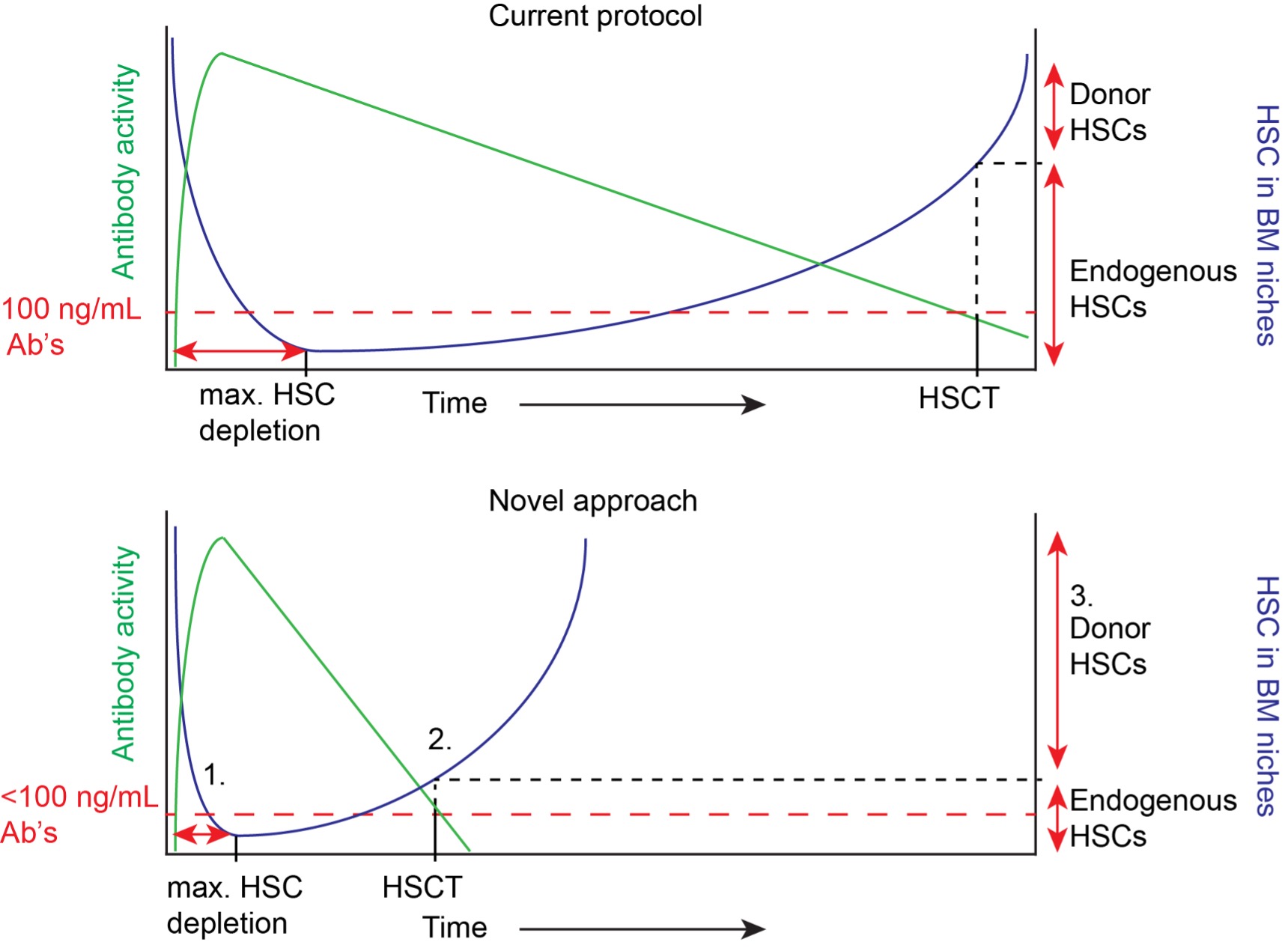
Figure 2: Schematic overview of the kinetics of current c-KIT antibody-mediated depletion of HSCs and our novel approach. We expect to improve the current HSCT protocol in three ways: 1. Due to improved activity of HSC-eliminating antibodies the maximum depletion of HSCs will be reached at earlier time-point. Also, the concentration limit, which will be different per antibody, will be reduced. 2. Due to the short half-life of the c-KIT antibodies, patients can be transplanted at an earlier time-point with less interfering antibodies in the host leading to improved engraftment. 3. Due to the optimized kinetics, we expect to reach higher percentages of donor chimerism after HSCT. Green: Antibody activity, Blue: host HSC in BM niches, Red: concentration limit Ab’s for HSC transplantation.
Andere projecten
In elk PPS-project werken kennisinstellingen, bedrijven en zorgpartijen samen aan een concrete gezondheidsvraag. Bekijk het volledige projectoverzicht.

Bekijk de programma’s
Binnen onze programma’s werken bedrijven, kennisinstellingen en regionale partners samen aan innovaties die bijdragen aan betere gezondheid en zorg.
Bekijk de partnerschappen
Strategische publiek-private partnerschappen (PPP's) zijn meerjarige samenwerkingen tussen bedrijven, kennisinstellingen en andere partijen.
Hoe kunnen we je helpen?
Heb je een vraag of wil je meer weten over Health Holland? We brengen je graag in contact met de juiste mensen, kennis en mogelijkheden om gezondheidsinnovatie te versnellen.
We hebben uw bericht ontvangen
We nemen binnen 3 tot 4 werkdagen contact met je op. Is je vraag dringend? Neem dan gerust direct contact met ons op. Hieronder zie je de contactoptie die het beste past bij je onderwerp.
Opnieuw beginnen
Er ging iets mis bij het versturen van het formulier. Probeer het opnieuw.