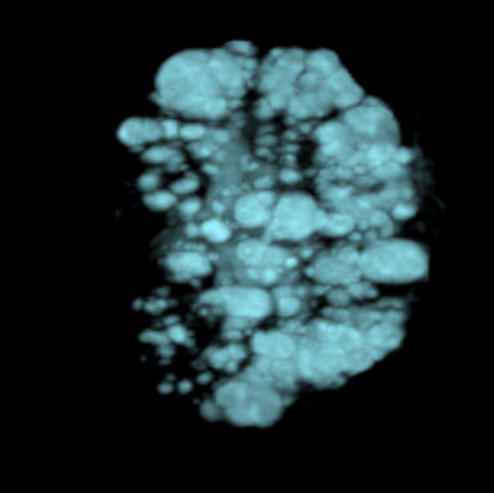
An advanced microfluidic model to study and test drugs for polycystic kidney disease
Developing a PKD-on-a-chip model to study early molecular mechanisms driving cystogenesis, and for drug testing
Autosomal Dominant Polycystic Kidney Disease (PKD) is characterized by many fluid-filled cysts that lead to kidney failure. Cyst formation involves complex molecular interactions among different cell types. Advanced cell cultures mimicking the disease are needed for analysis, characterization, and drug discovery. In this project, we aim to develop a PKD 3Dimensional microfluidic device with luminal fluid flow, focal dilation, and multiple cell types, in collaboration with PimBio B.V. This model will be used to study cyst initiation and expansion, and to analyze molecular alterations driving cystogenesis using molecular methods, as well as sophisticated imaging with Confocal.nl B.V.. The model will be validated for testing drugs that specifically target the formation and growth of cysts, aiming to slow or halt disease progression in ADPKD patients.
ADPKD is an inherited kidney disorder with a prevalence of 3:10.000. The disease is characterized by a progressive increase in the number and size of cysts, leading to renal failure around the age of 50-60, necessitating dialysis and/or transplantation. ADPKD patients represent 10% of end-stage renal failure cases. Tolvaptan (Jinarc) is the only approved drug in the Netherlands, but its adverse effects limit use. Developing well-tolerated treatments to slow PKD progression is crucial, potentially reducing healthcare costs and improving patient participation in society.
We will generate an advanced PKD 3D microfluidic model. The model will be used to obtain detailed insights into molecular alterations driving cystogenesis, using different techniques. Critical factors that initiate cyst formation will be tested and the model will be validated for drug testing.
Overall we will establish a multi-cell type microfluidic model in which we can induce tubular dilation, which will be validated for drug testing. Detailed molecular analyses will provide us critical pathways in cyst formation (that can be inhibited with drugs).
Andere projecten
In elk PPS-project werken kennisinstellingen, bedrijven en zorgpartijen samen aan een concrete gezondheidsvraag. Bekijk het volledige projectoverzicht.

Bekijk de programma’s
Binnen onze programma’s werken bedrijven, kennisinstellingen en regionale partners samen aan innovaties die bijdragen aan betere gezondheid en zorg.
Bekijk de partnerschappen
Strategische publiek-private partnerschappen (PPP's) zijn meerjarige samenwerkingen tussen bedrijven, kennisinstellingen en andere partijen.
Hoe kunnen we je helpen?
Heb je een vraag of wil je meer weten over Health Holland? We brengen je graag in contact met de juiste mensen, kennis en mogelijkheden om gezondheidsinnovatie te versnellen.
We hebben uw bericht ontvangen
We nemen binnen 3 tot 4 werkdagen contact met je op. Is je vraag dringend? Neem dan gerust direct contact met ons op. Hieronder zie je de contactoptie die het beste past bij je onderwerp.
Opnieuw beginnen
Er ging iets mis bij het versturen van het formulier. Probeer het opnieuw.