
Fluorescent protein biomarker reporters in 3D patient-derived cancer models for imaging-based drug screening
Improved anticancer drug discovery screens require mechanism-based phenotypic screens using human relevant tumor models
Cancer is the most common cause of cancer in the Western world. While in the past two decades, understanding of mechanisms of cancer development and progression has resulted in various new targeted cancer therapeutics that entered the clinic, the overall success rate of novel candidate anticancer drugs that make it to the clinic is low. This is largely due to limited efficacy in the clinical setting. There is an urgent need to better select drug leads that can progress to the clinic. To bridge this need the past few years have seen a strong push for the development of patient-derived 3D cancer organoid models that can be applied for drug screening. So far these 3D cancer organoid screens are largely based on simple cell survival measurements and lack quantitative biomarkers that reflect key elements of cancer development and progression. We hypothesized that the integration of such biomarkers in patient-derived 3D cancer organoid models would further enable the early selection of the right candidate drugs for further drug development. This project aimed to establish fluorescent protein biomarker 3D cancer test systems and to optimize these models for drug screening applications using high throughput microscopy approaches. We have integrated relevant fluorescent markers for the cell cycle in a panel of Triple-Negative Breast Cancer (TNBC) models. We have optimized these fluorescent reporter models for high-content imaging approaches and then established image analysis pipelines to extract quantitative measurements of the proliferative and invasive capacity of those cancer models in 3D. Finally, we performed a proof-of-concept demonstration screen making use of a Kinases Inhibitor library containing 760 compounds to establish the applicability of our novel fluorescent protein biomarker 3D cancer models for future commercial screening campaigns.
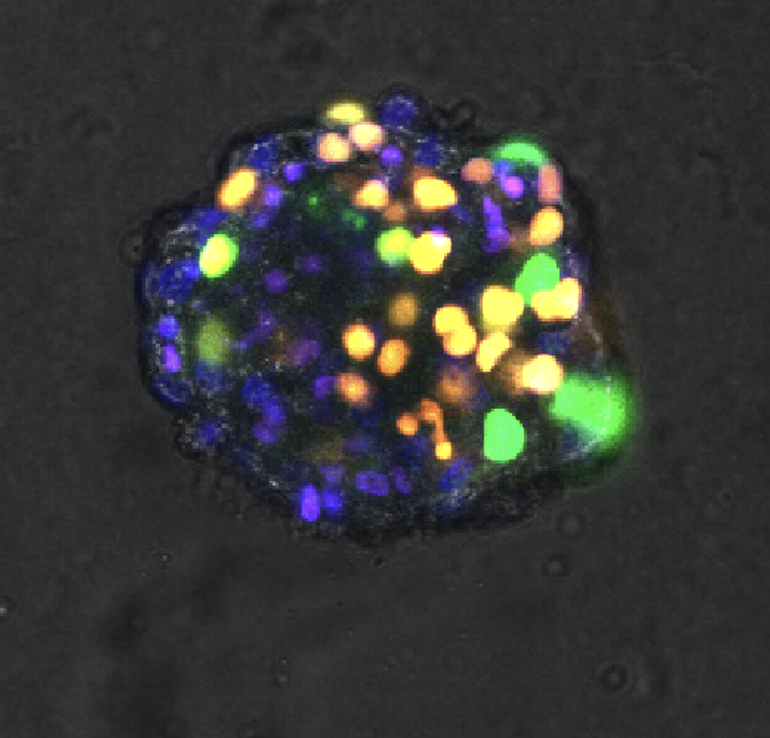
Legend: breast cancer microtissue expressing the FUCCI reporter, cultured in a 3D environment and imaged with confocal microscopy.
Andere projecten
In elk PPS-project werken kennisinstellingen, bedrijven en zorgpartijen samen aan een concrete gezondheidsvraag. Bekijk het volledige projectoverzicht.
Bekijk de programma’s
Binnen onze programma’s werken bedrijven, kennisinstellingen en regionale partners samen aan innovaties die bijdragen aan betere gezondheid en zorg.
Bekijk de partnerschappen
Strategische publiek-private partnerschappen (PPP's) zijn meerjarige samenwerkingen tussen bedrijven, kennisinstellingen en andere partijen.
Hoe kunnen we je helpen?
Heb je een vraag of wil je meer weten over Health Holland? We brengen je graag in contact met de juiste mensen, kennis en mogelijkheden om gezondheidsinnovatie te versnellen.
We hebben uw bericht ontvangen
We nemen binnen 3 tot 4 werkdagen contact met je op. Is je vraag dringend? Neem dan gerust direct contact met ons op. Hieronder zie je de contactoptie die het beste past bij je onderwerp.
Opnieuw beginnen
Er ging iets mis bij het versturen van het formulier. Probeer het opnieuw.