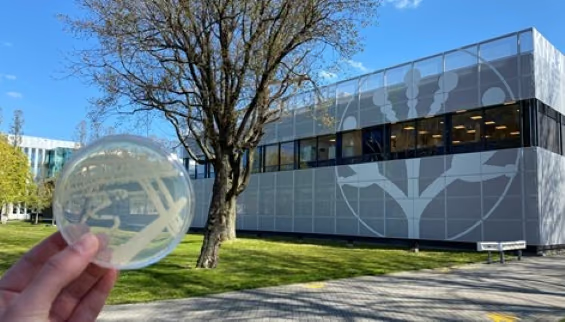
Intestinal Yeasts associated with Inflammatory Bowel Disease and Irritable Bowel Syndrome (YBD/S)
YBD/S studies the impact of fecal yeast diversity on bowel inflammation and irritable bowel syndrome
YBD/S studies the impact of fecal yeasts diversity on bowel diseases in a new public-private partnership involving the Westerdijk Fungal Biodiversity Institute, Tytgat Institute for Liver and Intestinal Research, QVQ Holding B.V. and CBMR Scientific B.V.
This study focusses on chronic intestinal diseases, in this context being Inflammatory Bowel Diseases (IBD) and Irritable Bowel Syndrome (IBS). In 2017, IBD affected 6.8 million people globally. In the Netherlands, about 1 in 200 people suffers from IBD. Irritable Bowel Syndrome (IBS), characterized by frequent abdominal pain, is the most frequent functional gastrointestinal disorder worldwide, affecting 2 million people in the Netherlands only. Patients often experience pain as debilitating, leading to high economic and healthcare costs.
Although IBD and IBS have a multifactorial nature, recent investigations have pointed towards a prominent role of intestinal fungi including the yeasts Candida albicans and Saccharomyces cerevisiae. Altered fungal communities have been described for both IBD and IBS, compared to healthy controls. However, yeasts themselves also contain genetic variation. The altered genetic composition leads to different behaviors such as interactions with intestinal cells. In this project, we studied the genetic and phenotypic variation of these intestinal yeasts, and evaluated their sensitivity to antimicrobial compounds.
YBD/S resulted in an extensive collection of faeces-derived yeast samples, and genotypic analysis indicated high inter-patient variation of C. albicans strains. We did not observe differential enzymatic activity between groups of intestinal diseases (e.g., ulcerative colitis vs. Crohn’s disease). Our data points towards a possible correlation between the functionality of C. albicans and severity of disease, but whether this is clinically relevant remains to be determined.
Andere projecten
In elk PPS-project werken kennisinstellingen, bedrijven en zorgpartijen samen aan een concrete gezondheidsvraag. Bekijk het volledige projectoverzicht.
Bekijk de programma’s
Binnen onze programma’s werken bedrijven, kennisinstellingen en regionale partners samen aan innovaties die bijdragen aan betere gezondheid en zorg.
Bekijk de partnerschappen
Strategische publiek-private partnerschappen (PPP's) zijn meerjarige samenwerkingen tussen bedrijven, kennisinstellingen en andere partijen.
Hoe kunnen we je helpen?
Heb je een vraag of wil je meer weten over Health Holland? We brengen je graag in contact met de juiste mensen, kennis en mogelijkheden om gezondheidsinnovatie te versnellen.
We hebben uw bericht ontvangen
We nemen binnen 3 tot 4 werkdagen contact met je op. Is je vraag dringend? Neem dan gerust direct contact met ons op. Hieronder zie je de contactoptie die het beste past bij je onderwerp.
Opnieuw beginnen
Er ging iets mis bij het versturen van het formulier. Probeer het opnieuw.