
Home Monitoring & E-health for Inflammatory Bowel Disease
This project aims to detect and predict flare-ups and help patients monitor Inflammatory Bowel Disease at home using smart technologies.
This project aims to detect and predict flare-ups and help patients monitor IBD at home using smart technologies.
Continuous remote monitoring can provide doctors with objective data on the physiological changes and inflammation state in IBD, which is currently lacking. Better understanding and predicting flare-ups can improve the patient's quality of life and reduce healthcare costs. The project offers unique novel way of monitoring IBD, combining expertise from RUMC, Imec-NL and Galapagos. Until now e-Health tools have been questionnaire-based and no non-invasive home measurements have been developed for IBD.
Early detection of flare-ups in Inflammatory Bowel Disease could have significant short- and long-term societal impacts, as well as a significant economic impact on healthcare systems, insurers and patients. Short-term impact include the improvement in the quality of life of individuals living with IBD as their ability to be able to manage their disease more effectively, and avoid severe flare-ups that can lead to emergency room visits, hospitalization and other complications, thereby reducing the need for costly hospitalizations and surgeries. Improved disease management can also lead to increased productivity among patients and reduced absenteeism, which can have positive economic effects on individuals, employers, and society at large.
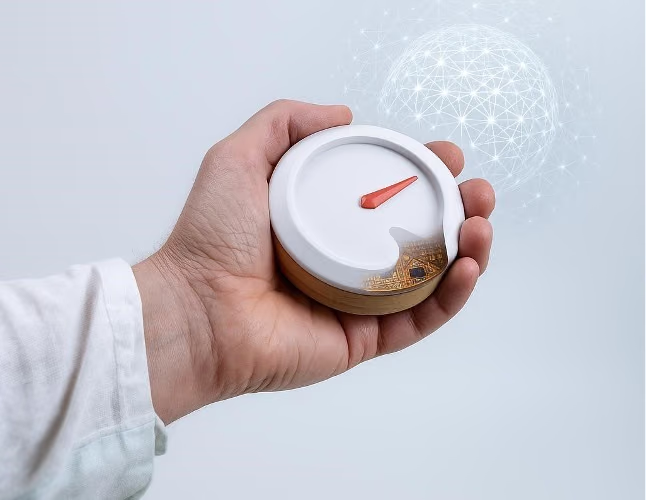
The scientific impact of our project could lead to new discoveries about the pathophysiology of the disease and its triggers. Where research has mainly studied IBD parameters in isolation in a controlled environment, the toilet seat offers a unique, novel and objective way of monitoring multiple vital parameters non-invasively at home over longer periods of time.
The data generated from the project could be used to inform further research and improve our understanding of the disease, ultimately leading to better prevention and management strategies. The project could also contribute to the development of personalized medicine approaches that take into account individual patient characteristics and disease progression.
The project is divided into four work packages, with specific deliverables, as shown in the table below:
Work Packages DeliverablesWP1
Outcomes of the panel study and focus group with actionable recommendations for the long-term trial.
WP2
Preliminary data model
Overview of possible improvements on the seat
Results that can be published in a scientific paper
WP3
Recruitment of participants for:
- Trial participation (10 for CD study)
The first data on the relationship between physiological parameters, patient wellbeing and inflammatory markers with CD.
Data on the patient perspective on the use of the monitoring device at home.
WP4
Recruitment of participants for:
-Panel studies (approx. 40 total patients, at least 5 doctors)
-Trial participation (approx. 30 total, 10 for CD study, 20 for long-term)
Additional data on the relationship between physiological parameters, patient wellbeing and inflammatory markers
Additional data on the patient perspective on the use of the monitoring device at home.
Andere projecten
In elk PPS-project werken kennisinstellingen, bedrijven en zorgpartijen samen aan een concrete gezondheidsvraag. Bekijk het volledige projectoverzicht.
Bekijk de programma’s
Binnen onze programma’s werken bedrijven, kennisinstellingen en regionale partners samen aan innovaties die bijdragen aan betere gezondheid en zorg.
Bekijk de partnerschappen
Strategische publiek-private partnerschappen (PPP's) zijn meerjarige samenwerkingen tussen bedrijven, kennisinstellingen en andere partijen.
Hoe kunnen we je helpen?
Heb je een vraag of wil je meer weten over Health Holland? We brengen je graag in contact met de juiste mensen, kennis en mogelijkheden om gezondheidsinnovatie te versnellen.
We hebben uw bericht ontvangen
We nemen binnen 3 tot 4 werkdagen contact met je op. Is je vraag dringend? Neem dan gerust direct contact met ons op. Hieronder zie je de contactoptie die het beste past bij je onderwerp.
Opnieuw beginnen
Er ging iets mis bij het versturen van het formulier. Probeer het opnieuw.