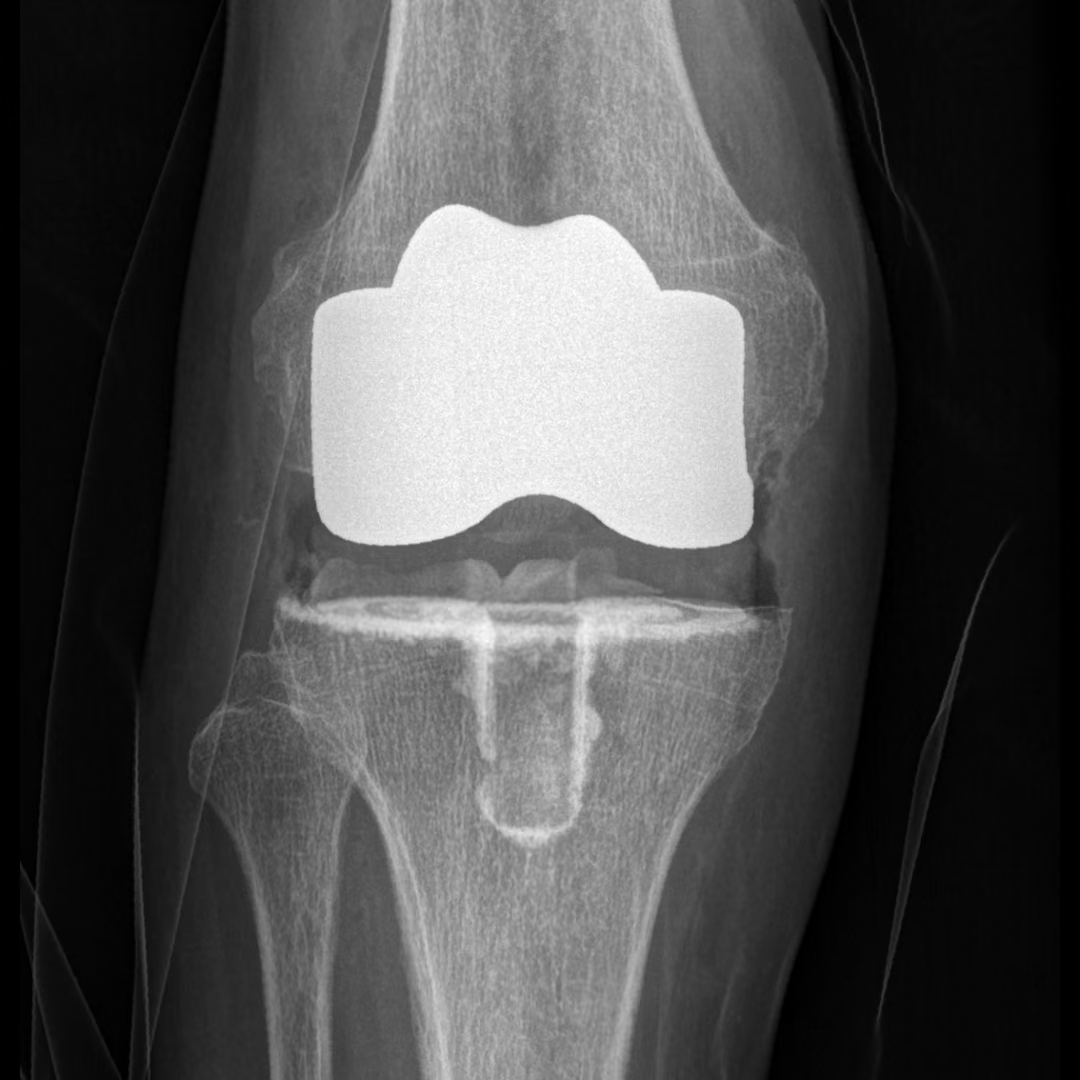
Advanced analysis of primary fixation of total knee arthroplasty components
This project investigates mechanical fixation of total knee arthroplasty implants in the human body
This collaboration between the Orthopaedic Research Lab of Radboudumc (Nijmegen, The Netherlands) and DePuy Synthes (Leeds, UK) focused on the primary fixation of total knee replacement implants. Total knee replacement is a popular orthopaedic intervention for patients suffering from degenerated knees, with more than 1.0 million operations each year in EU. The operation provides pain relief and restores patient mobility, but it currently does not provide a life-long solution, particularly for younger patients. This project investigated the fundamental principles of implant fixation to support the development of new, long-lasting implant systems.
The project combined experimental testing and computational modeling to investigate the (bio)mechanics of implant fixation. Experimental tests were performed with cadaver bone tissue to establish the mechanical response of the bone, with a particular focus on the combination of creep, relaxation, and plastic deformation of the bone. Based on the cadaver tests, material models were developed that served as input for advanced computational models. The computational models were subsequently used to simulate the fixation of total knee replacement implants. The computer models simulated the relative motions at the interface between the implant and the bone, also referred to as ‘micromotions’, which are a measure for how bone will grow into the implant surface, providing long-term stability and fixation. Additional analyses were performed simulating pull-off tests of implants to further investigate the initial stability.
The project results demonstrated that incorporating the viscoelastic response did not lead to a significant improvement of the simulations. As an additional improvement to the model bone abrasion was incorporated in the simulations. Bone abrasion occurs during the implantation of the implants, during which bone is scraped off the interface by the rough implant surface coating. Adding abrasion led to a significant improvement of the simulations, both for the femoral (thigh bone) and tibial (shin bone) components. The developed viscoelastic material model and the new insights into the effect of abrasion are very useful in the design and development process of press-fit joint replacement devices. The methods developed in the project allow for evaluation of implant design choices, such as implant material, coating roughness, and interference fit (the amount of press-fit that is designed into the system through the implants and surgical instruments). These tools allow for the design of new, better implant systems, with the objective to develop implants that last a lifetime.
Andere projecten
In elk PPS-project werken kennisinstellingen, bedrijven en zorgpartijen samen aan een concrete gezondheidsvraag. Bekijk het volledige projectoverzicht.
Bekijk de programma’s
Binnen onze programma’s werken bedrijven, kennisinstellingen en regionale partners samen aan innovaties die bijdragen aan betere gezondheid en zorg.
Bekijk de partnerschappen
Strategische publiek-private partnerschappen (PPP's) zijn meerjarige samenwerkingen tussen bedrijven, kennisinstellingen en andere partijen.
Hoe kunnen we je helpen?
Heb je een vraag of wil je meer weten over Health Holland? We brengen je graag in contact met de juiste mensen, kennis en mogelijkheden om gezondheidsinnovatie te versnellen.
We hebben uw bericht ontvangen
We nemen binnen 3 tot 4 werkdagen contact met je op. Is je vraag dringend? Neem dan gerust direct contact met ons op. Hieronder zie je de contactoptie die het beste past bij je onderwerp.
Opnieuw beginnen
Er ging iets mis bij het versturen van het formulier. Probeer het opnieuw.