
Vectorized Antibody Treatment of Dementia in Synucleinopathies (VADemS) evaluated in Novel Parkinson model
Project aimed at assessing safety and efficacy of vectorized antibody treatment in Parkinson animal model
Research into a New Treatment for Parkinson’s Disease
In collaboration with the Netherlands Institute for Neuroscience and the Biomedical Primate Research Centre, Syngle is developing a new model to better study Parkinson’s disease. This model will be used to test Syngle’s new treatment involving special antibodies. The researchers hope to determine whether this treatment is safe and effective so that it can later be tested in humans.
Dementia is common among people with Parkinson’s disease. Approximately 24-50% of the 7 million patients worldwide experience it, and in later stages of the disease, this number rises to 80%. In addition to movement problems such as tremors and stiffness, memory loss is one of the most severe symptoms. Currently, there is no cure—only treatments that temporarily relieve symptoms.
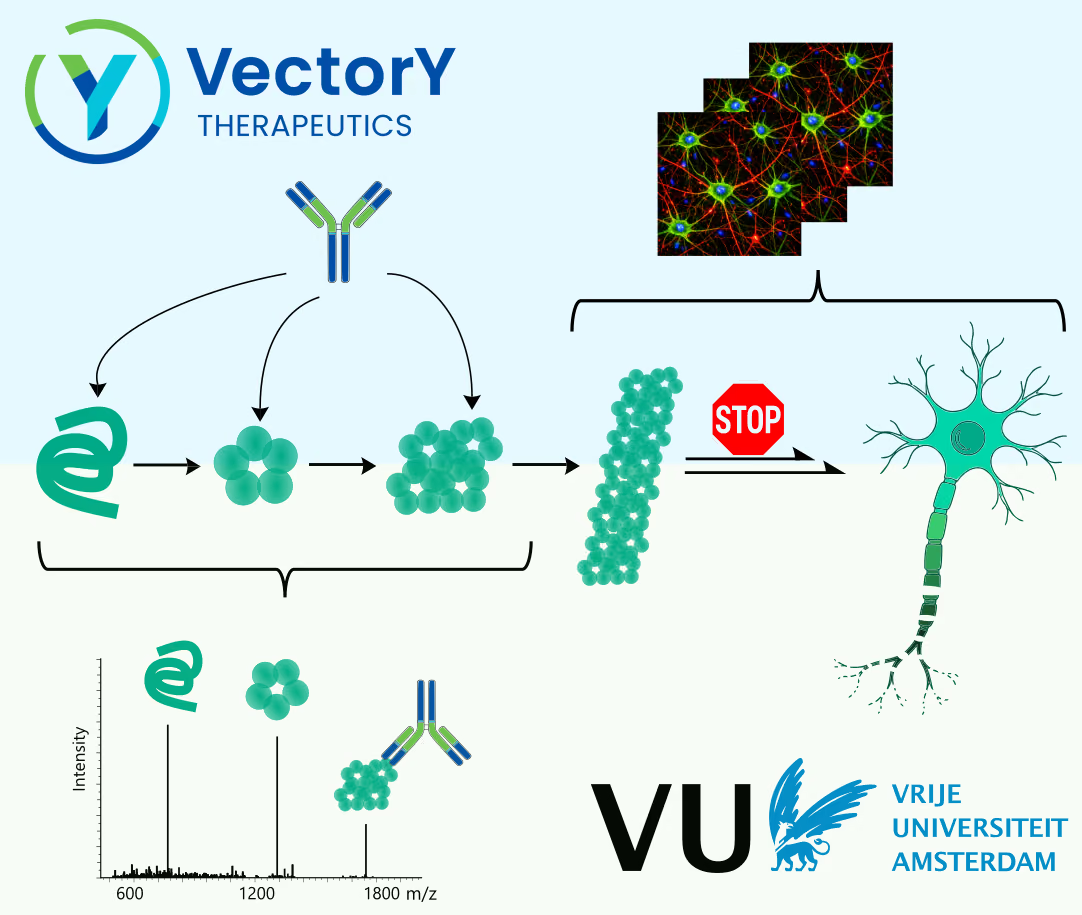
Parkinson’s disease is caused by the accumulation of a protein called alpha-synuclein, which is toxic to brain cells. Syngle has developed a treatment designed to remove these harmful proteins. In earlier tests, this treatment was shown to protect brain cells and reduce movement problems. This new study aims to determine whether the treatment is also effective in a model that more closely resembles humans. If successful, the treatment can then be tested in people with Parkinson’s disease, with the goal of slowing or even stopping disease progression.
This project has two key objectives:
- Preparing Syngle’s new treatment for human trials.
- Developing a model that will allow scientists and drug developers to conduct further research on Parkinson’s and similar diseases in the future.
Both objectives contribute to finding better treatments for Parkinson’s disease.
Andere projecten
In elk PPS-project werken kennisinstellingen, bedrijven en zorgpartijen samen aan een concrete gezondheidsvraag. Bekijk het volledige projectoverzicht.

Bekijk de programma’s
Binnen onze programma’s werken bedrijven, kennisinstellingen en regionale partners samen aan innovaties die bijdragen aan betere gezondheid en zorg.
Bekijk de partnerschappen
Strategische publiek-private partnerschappen (PPP's) zijn meerjarige samenwerkingen tussen bedrijven, kennisinstellingen en andere partijen.
Hoe kunnen we je helpen?
Heb je een vraag of wil je meer weten over Health Holland? We brengen je graag in contact met de juiste mensen, kennis en mogelijkheden om gezondheidsinnovatie te versnellen.
We hebben uw bericht ontvangen
We nemen binnen 3 tot 4 werkdagen contact met je op. Is je vraag dringend? Neem dan gerust direct contact met ons op. Hieronder zie je de contactoptie die het beste past bij je onderwerp.
Opnieuw beginnen
Er ging iets mis bij het versturen van het formulier. Probeer het opnieuw.