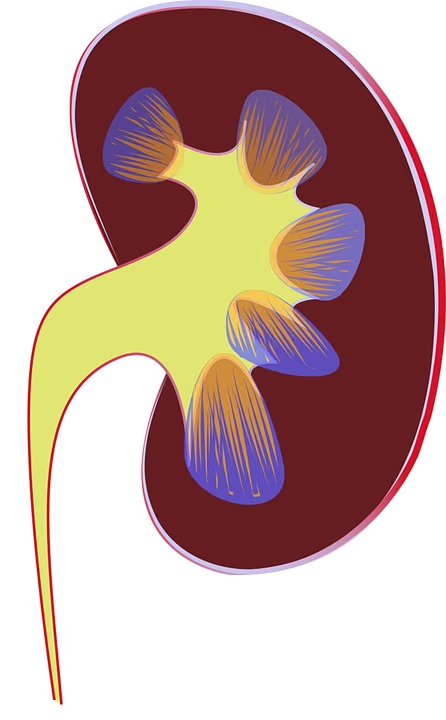
Improved Risk Stratification prior to Kidney Transplantation by Discriminating Pathogenic from Clinically Irrelevant Donor Specific HLA antibodies in relation to complement activation
This study will define kidney donors which can be safely used for transplantation without risk of rejection
Kidney transplantation is the best option for end-stage kidney failure. Loss of the transplant is a major limitation of this therapy. Considering the shortage of donor kidneys, it is of outmost importance to maximize the match between donors and recipients. In this study, the Dutch Kidney Foundation, Health Holland, Hycult and the UMCU will join forces to improve a better match bewteen patients and donors, reducing the change on kidney graft loss.
Since 2014 all 8 University Medical Centers in the Netherlands have joined forces in the PROCARE consortium to redefine the matching strategy currently used for organ allocation by performing a comprehensive analysis of immunological risk factors for rejection and graft loss. One of the most important parameters studied is the clinical significance of luminex-defined donor-specific HLA antibodies (DSA). Analysis of sera taken prior to transplantation with kidneys from 4770 kidneys from deceased donors, indicated that the presence of luminex-defined DSA increase the risk of rejection by 16% over a period of 10 years compared to transplantation in the absence of DSA.
Pre-transplant assessment of DSA is currently used by all Dutch centers for risk stratification. However, it is evident that not all luminex-defined DSA are clinically relevant as 60% of grafts still function after 10 years despite the presence of pre-transplant DSA. This excludes applicability on a patient-specific level.
In this study we intend to refine the pre-transplant risk stratification for graft loss by defining the pathogenicity of DSA and contribution of complement activation profile for prediction and screening of transplanted patients. The aim of the study is to deliver additional specific diagnostic tests for DSA that induce rejection.
Andere projecten
In elk PPS-project werken kennisinstellingen, bedrijven en zorgpartijen samen aan een concrete gezondheidsvraag. Bekijk het volledige projectoverzicht.

Bekijk de programma’s
Binnen onze programma’s werken bedrijven, kennisinstellingen en regionale partners samen aan innovaties die bijdragen aan betere gezondheid en zorg.
Bekijk de partnerschappen
Strategische publiek-private partnerschappen (PPP's) zijn meerjarige samenwerkingen tussen bedrijven, kennisinstellingen en andere partijen.
Hoe kunnen we je helpen?
Heb je een vraag of wil je meer weten over Health Holland? We brengen je graag in contact met de juiste mensen, kennis en mogelijkheden om gezondheidsinnovatie te versnellen.
We hebben uw bericht ontvangen
We nemen binnen 3 tot 4 werkdagen contact met je op. Is je vraag dringend? Neem dan gerust direct contact met ons op. Hieronder zie je de contactoptie die het beste past bij je onderwerp.
Opnieuw beginnen
Er ging iets mis bij het versturen van het formulier. Probeer het opnieuw.