On-demand Prediction of ‘Freezing of Gait’ in Parkinson’s patients using Movement Data (FoG-Predict
We will predict Freezing of Gait in Parkinson's patients to prevent falls before they happen
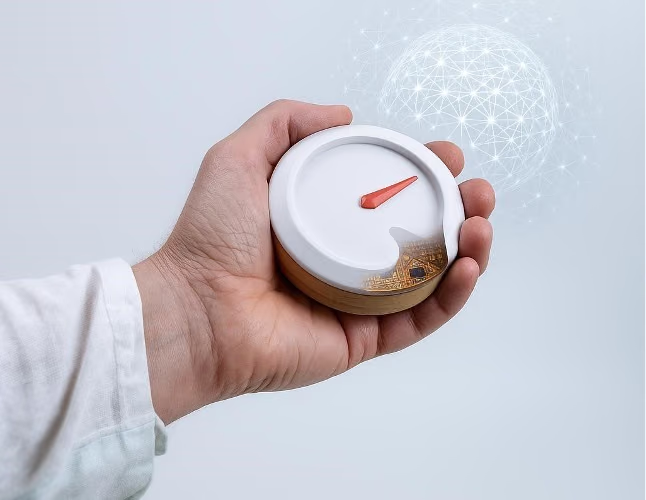
In this innovative project Cue2walk and TU Delft work together to transform how Parkinson's patients manage one of their most challenging symptoms, Freezing of Gait (FoG). Cue2walk has developed a smart wearable technology that detects freezing episodes and consequently provides cues. In this partnership the aim is to develop the world's first predictive system that can anticipate freezing before it happens. This allows for timely intervention and prevention rather than just reaction.
Parkinson's Disease is the fastest-growing neurological disease globally, affecting 10 million people worldwide and 63,500 in the Netherlands alone, a number expected to double by 2030. While there is no cure, maintaining an active lifestyle significantly improves quality of life. Unfortunately, freezing of gait severely limits mobility, causing falls that decrease self-confidence and create a vicious cycle of reduced activity. This project addresses this critical need by developing technology that helps patients maintain independence and activity.
Our approach involves creating an on-demand FoG prediction tool. Movement data (acceleration and gyroscopic measurements) will be collected and to identify patterns that precede freezing episodes. Using machine learning and decision tree algorithms designed to be simple and energy-efficient, we aim to predict FoG onset with 80% accuracy. This will allow the device to provide timely external cueing signals that help patients maintain their walking pattern before freezing occurs.
The project will deliver a validated prediction algorithm integrated into Cue2walk's existing wearable technology, supported by data from both controlled testing and real-world validation. By shifting from reactive to predictive intervention, this solution has the potential to significantly reduce fall incidents, decrease healthcare costs, and most importantly, improve the confidence and independence of people living with Parkinson's disease.
For more information about the projectAndere projecten
In elk PPS-project werken kennisinstellingen, bedrijven en zorgpartijen samen aan een concrete gezondheidsvraag. Bekijk het volledige projectoverzicht.

Bekijk de programma’s
Binnen onze programma’s werken bedrijven, kennisinstellingen en regionale partners samen aan innovaties die bijdragen aan betere gezondheid en zorg.
Bekijk de partnerschappen
Strategische publiek-private partnerschappen (PPP's) zijn meerjarige samenwerkingen tussen bedrijven, kennisinstellingen en andere partijen.
Hoe kunnen we je helpen?
Heb je een vraag of wil je meer weten over Health Holland? We brengen je graag in contact met de juiste mensen, kennis en mogelijkheden om gezondheidsinnovatie te versnellen.
We hebben uw bericht ontvangen
We nemen binnen 3 tot 4 werkdagen contact met je op. Is je vraag dringend? Neem dan gerust direct contact met ons op. Hieronder zie je de contactoptie die het beste past bij je onderwerp.
Opnieuw beginnen
Er ging iets mis bij het versturen van het formulier. Probeer het opnieuw.