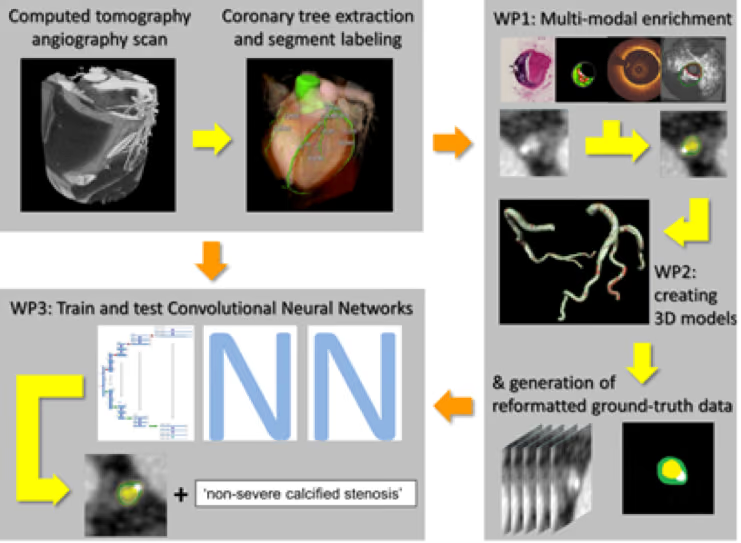
PRAGMATICS: A deep learning approach to plaque segmentation, classification and lesion phenotyping in Computed Tomography Angiographic images
PRAGMATICS aims to develop a deep learning network to provide qualitative descriptions of coronary plaques
PRAGMATICS is a cooperation between Leiden University Medical Center and Medis Medical Imaging B.V. and aims to developed a deep learning network to provide quantitative and qualitative descriptions of coronary plaques.
Coronary Artery Disease (CAD) remains the number one cause of mortality and morbidity in the western world. In the 1990s, non-invasive coronary angiography with computed tomography (CT) has been introduced. CT angiography (CTA) has shown to have high sensitivity and specificity for detecting CAD, as compared to invasive coronary angiography.
With newly developed scanners and continuous improving scan protocols, existing plaque delineation methods have to be adapted to the new images, which is time consuming and inefficient. The recent developments in the application of deep learning in the field of medical image processing enables automated learning by examples to adapt image processing systems and already has shown to be a very successful technique in different image analysis applications.
Two technical challenges will be addressed:
- The design, training and testing of a CNN that is able to adapt to the changing types of CTA scans. It has to provide a detailed delineation and classification of plaque as well as typing a detected lesion.
- Accurate 3D volumetric modelling of the coronary tree including the bifurcations, plaque composition and lesion phenotyping. This allows for the generation of ground truth example.
Ultimately, the proposed software will help the medical professional with early diagnosis with the selection of the proper treatment and a better risk prediction for the patient. This will contribute to more personalised therapy, with benefits for the patient and the medical professional.
Andere projecten
In elk PPS-project werken kennisinstellingen, bedrijven en zorgpartijen samen aan een concrete gezondheidsvraag. Bekijk het volledige projectoverzicht.

Bekijk de programma’s
Binnen onze programma’s werken bedrijven, kennisinstellingen en regionale partners samen aan innovaties die bijdragen aan betere gezondheid en zorg.
Bekijk de partnerschappen
Strategische publiek-private partnerschappen (PPP's) zijn meerjarige samenwerkingen tussen bedrijven, kennisinstellingen en andere partijen.
Hoe kunnen we je helpen?
Heb je een vraag of wil je meer weten over Health Holland? We brengen je graag in contact met de juiste mensen, kennis en mogelijkheden om gezondheidsinnovatie te versnellen.
We hebben uw bericht ontvangen
We nemen binnen 3 tot 4 werkdagen contact met je op. Is je vraag dringend? Neem dan gerust direct contact met ons op. Hieronder zie je de contactoptie die het beste past bij je onderwerp.
Opnieuw beginnen
Er ging iets mis bij het versturen van het formulier. Probeer het opnieuw.