Contractile force of muscle fibers in Pompe disease and Facioscapulohumeral muscular dystrophy
We have measured contractile forces of individual fibers and fibrils from diseased skeletal muscles
We have generated a new device that is user-friendly for non-specialist scientists with which it is possible to measure contractile forces of individual fibers and fibrils from healthy and diseased skeletal muscles. To this end we have collaborated in a consortium that brings together the different required expertise: The company Ionoptix, specialized in high-sensitive force measurements and commercializing devices thereof; Amsterdam UMC for bringing force measurement expertise, Erasmus MC and LUMC for expertise on studying human skeletal muscles in the laboratory and on the diseases Pompe disease and FSHD. While there are >700 neuromuscular disorders, for only very few a treatment option is available. A major reason for the lack of therapies is the scarcity of human models for preclinical research. To overcome this limitation, we developed here technology to assess the basic and single most important function of skeletal muscle, contraction, from its smallest units, the fibrils. This forms an important read out for muscle function relevant for understanding mechanisms of disease and for testing novel treatment options. This will increase the chance of success of drugs in clinical trials, thereby accelerating drug development and lowering disease burden, with positive impact on society and economics. We have developed a device that can measure contractile forces that are in the nano-Newton range. We used it to measure forces of matured muscle fibers and their small contractile units termed fibrils, and we have assessed fiber and fibril contraction in Pompe disease and FSHD. The results of this project form a next level technology for the assessment of skeletal muscle function, relevant for the development of treatment options in disease.
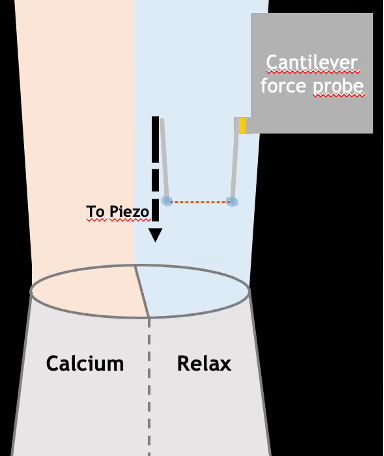
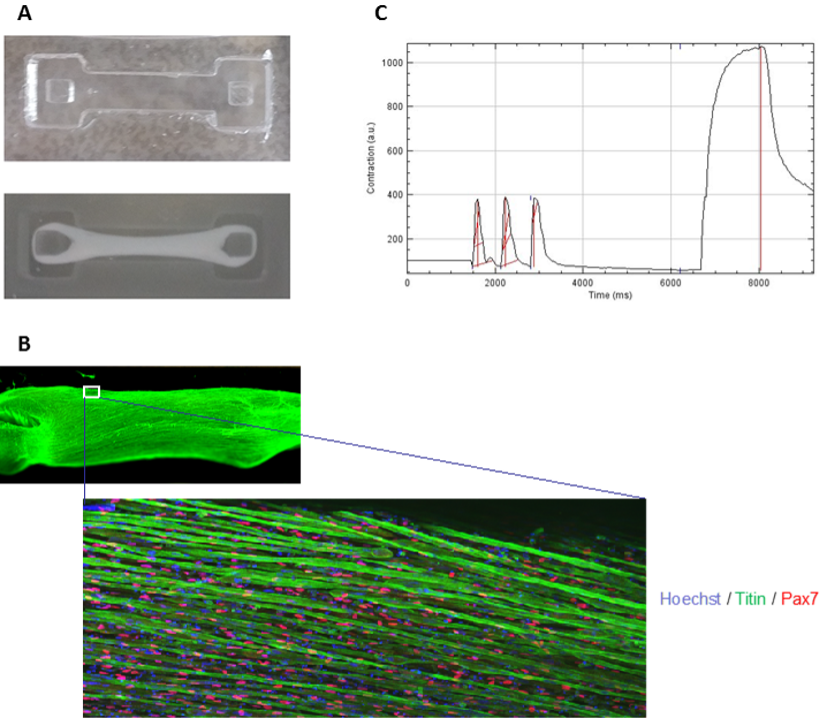 Figure: human muscle generated in the laboratory as model system to study muscle disease. A. Top view of culture chamber (above) for a 3D human muscle tissue (below). B A cultured human 3D muscle. The inset shows parallel muscle fibers (in green), muscle stem cells (in red), and nuclei (in blue). C. Example of force measurements of 3D muscles. D. Principle of fibril force measurement.
Andere projecten
In elk PPS-project werken kennisinstellingen, bedrijven en zorgpartijen samen aan een concrete gezondheidsvraag. Bekijk het volledige projectoverzicht.
Bekijk de programma’s
Binnen onze programma’s werken bedrijven, kennisinstellingen en regionale partners samen aan innovaties die bijdragen aan betere gezondheid en zorg.
Bekijk de partnerschappen
Strategische publiek-private partnerschappen (PPP's) zijn meerjarige samenwerkingen tussen bedrijven, kennisinstellingen en andere partijen.
Hoe kunnen we je helpen?
Heb je een vraag of wil je meer weten over Health Holland? We brengen je graag in contact met de juiste mensen, kennis en mogelijkheden om gezondheidsinnovatie te versnellen.
We hebben uw bericht ontvangen
We nemen binnen 3 tot 4 werkdagen contact met je op. Is je vraag dringend? Neem dan gerust direct contact met ons op. Hieronder zie je de contactoptie die het beste past bij je onderwerp.
Opnieuw beginnen
Er ging iets mis bij het versturen van het formulier. Probeer het opnieuw.