EnFORCE: Enabling Functional Omics in Routine Clinical Environments by solving computational bottlenecks in mass spectrometry based proteomics
The EnFORCE project develops solutions for real-time processing of mass spectrometry data in clinical laboratories
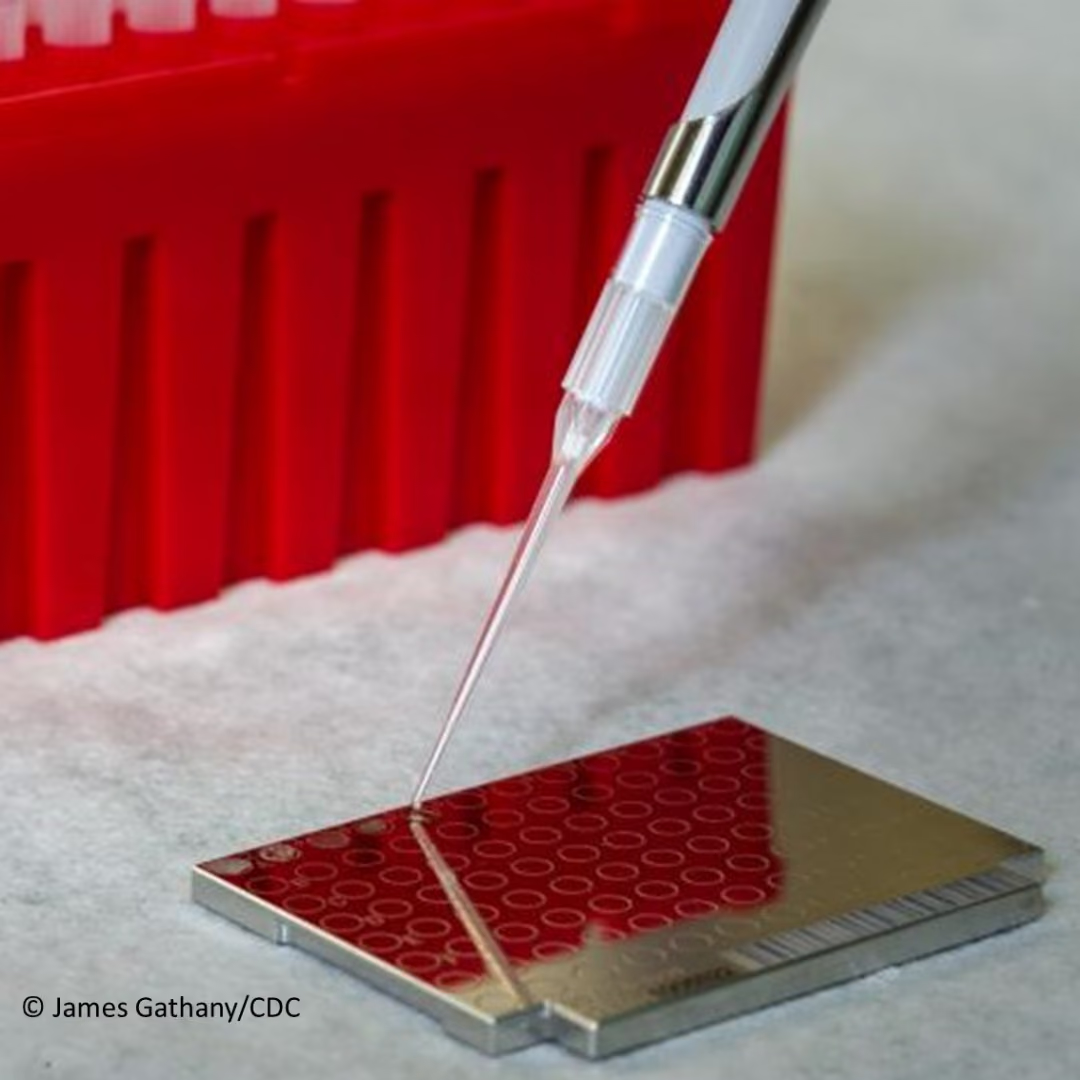
Molecular diagnostics is a key asset in personalised healthcare to diagnose disease and to ensure that each individual receives the right treatment at the right time. Recent developments in holistic mass spectrometry enabled robust measurement of up to tens of thousands of biomarkers from a single drop of blood. The main bottleneck for implementation in clinical practice is however a lack of efficient data workflows to translate complex data into lucid test-reports. The EnFORCE project is a public-private partnership between the Radboudumc and Bruker Daltonics to develop real-time data processing solutions that will solve this bottleneck.
Holistic data acquisition in routine diagnostics is highly anticipated as it enables retrospective analysis of biomarkers or even discovery of novel biomarkers from a single experiment thereby eliminating the tedious process of developing and applying different methods for biomarker discovery and application. Comprehensive molecular information gained from a single laboratory test will provide new insights and information of the disease status and the effect of therapies for improved patient care.
Two complementary diagnostic workflows will be developed in EnFORCE to cover key components for a broad range of clinical applications. Workpackage 1 will develop data workflows for clinical implementation of proteome expression data in minimal residual disease patientcare. Workpackage 2 will develop data workflows for clinical implementation of glycopeptide-based protein glycosylation profiling in diagnosis of congenital disorders of glycosylation.
Diagnostic workflows developed by EnFORCE will enable routine implementation of functional proteomics in personalized and large-scale population biomarker applications. Quality of life for patients will improve by less cumbersome, faster, and successful diagnostics as well as personalized treatment strategies by better informed decisions. Knowledge gained in EnFORCE on how to implement real-time computing for clinical holistic mass spectrometry will lay the foundations for subsequent industrial development of a commercially available solution for clinical laboratories.
Molecular diagnostics is a key asset in personalized healthcare to diagnose disease and to ensure that each individual receives the right treatment at the right time. Recent developments in holistic mass spectrometry enabled robust measurement of up to tens of thousands of biomarkers from a single drop of blood. The main bottleneck for implementation in clinical practice is however a lack of efficient data workflows to translate complex data into lucid test-reports. The EnFORCE project is a public-private partnership between the Radboudumc and Bruker Daltonics to develop real-time data processing solutions that will solve this bottleneck.
Holistic data acquisition in routine diagnostics is highly anticipated as it enables retrospective analysis of biomarkers or even discovery of novel biomarkers from a single experiment thereby eliminating the tedious process of developing and applying different methods for biomarker discovery and application. Comprehensive molecular information gained from a laboratory test will provide new insights and information of the disease status and the effect of therapies for improved patient care.
Two diagnostic workflows were developed in EnFORCE. Workpackage 1 developed workflows for disease monitoring in blood from multiple myeloma patients with minimal residual disease. The second workpackage developed workflows for glycopeptide-based functional diagnosis of patients with congenital disorders of glycosylation.
For multiple myeloma, the novel technology from EnFORCE achieved >1000-fold better sensitivity compared to current diagnostics as a generic wetlab method with personalized digital workflow component that achieved realistic turn-around times for personalized test development for real-life applications. For congenital disorders of glycosylation, EnFORCE technology enabled accurate site-specific glycosylation profiling for successful clinical diagnosis and subtyping of patients including genetic defects that were overlooked by current diagnostics. In addition, a novel software solution “GlycoScape” including our new “Myriad” workflow for real-time glycopeptide identification was realized as spin-off which is installed in hundreds of laboratories worldwide.
More information about:
Andere projecten
In elk PPS-project werken kennisinstellingen, bedrijven en zorgpartijen samen aan een concrete gezondheidsvraag. Bekijk het volledige projectoverzicht.

Bekijk de programma’s
Binnen onze programma’s werken bedrijven, kennisinstellingen en regionale partners samen aan innovaties die bijdragen aan betere gezondheid en zorg.
Bekijk de partnerschappen
Strategische publiek-private partnerschappen (PPP's) zijn meerjarige samenwerkingen tussen bedrijven, kennisinstellingen en andere partijen.
Hoe kunnen we je helpen?
Heb je een vraag of wil je meer weten over Health Holland? We brengen je graag in contact met de juiste mensen, kennis en mogelijkheden om gezondheidsinnovatie te versnellen.
We hebben uw bericht ontvangen
We nemen binnen 3 tot 4 werkdagen contact met je op. Is je vraag dringend? Neem dan gerust direct contact met ons op. Hieronder zie je de contactoptie die het beste past bij je onderwerp.
Opnieuw beginnen
Er ging iets mis bij het versturen van het formulier. Probeer het opnieuw.