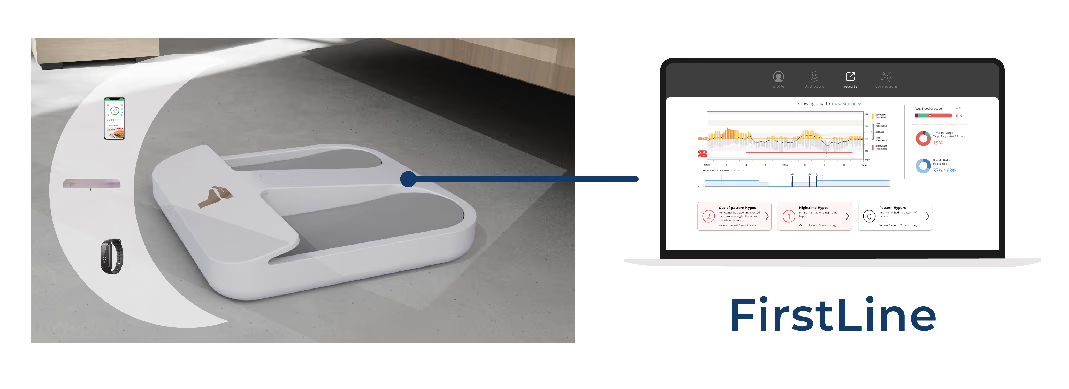
FirstLine: Cybersecurity by Design for Interoperable Medical Sensor Networks in Primary Care
Making medical sensors secure, trustworthy, and interoperable for home-based diabetes and other chronic care
The FirstLine project brings together four Dutch partners, TNO , Sensible, dHealthIQ and Secuped, to build a secure and open ecosystem for medical sensors used in primary care at home. Together, the consortium combining public and private partners investigates how sensors for, among others, glucose monitoring, foot ulcer prevention and lifestyle tracking can exchange data safely and reliably within a single open standard to support the future of personalized healthcare.
More than 1.1 million people in the Netherlands live with type 2 diabetes, with over 50,000 new diagnoses every year, and global numbers exceeding 550 million. An additional 1.4 million are living with pre-diabetes. Home monitoring with wearable sensors holds great promise for earlier intervention, but today’s sensor systems are fragmented and do not communicate securely across devices and healthcare platforms. This creates risks for data privacy and integrity and means that valuable signals go undetected in the noise until complications have already developed and heavier treatment regimens are needed.
FirstLine addresses this by designing sensor networks from the ground up with secure connectivity and analytics built in at every layer. The consortium develops guidelines, software components and a demonstration environment in which several sensor types work together safely. TNO leads the scientific research and risk analysis. Sensible and SecuPed jointly develop the cloud platform, software development kit, and the hardware and firmware components that connect physical sensors to the shared standard. dHealthIQ integrates everything into a frontend for care professionals, tested within Dutch primary care pathways for diabetes.
The project will deliver a validated security architecture for medical sensor networks, interoperability modules for safe data exchange across different hardware platforms and connectivity standards, a working demonstration system tested with healthcare stakeholders, and a freely accessible research report with concrete guidelines for sensor and software developers. These results are directly applicable to other small and medium-sized companies in health technology, enabling broader adoption of secure home monitoring across the Netherlands and beyond. Read more (in Dutch).
Andere projecten
In elk PPS-project werken kennisinstellingen, bedrijven en zorgpartijen samen aan een concrete gezondheidsvraag. Bekijk het volledige projectoverzicht.

Bekijk de programma’s
Binnen onze programma’s werken bedrijven, kennisinstellingen en regionale partners samen aan innovaties die bijdragen aan betere gezondheid en zorg.
Bekijk de partnerschappen
Strategische publiek-private partnerschappen (PPP's) zijn meerjarige samenwerkingen tussen bedrijven, kennisinstellingen en andere partijen.
Hoe kunnen we je helpen?
Heb je een vraag of wil je meer weten over Health Holland? We brengen je graag in contact met de juiste mensen, kennis en mogelijkheden om gezondheidsinnovatie te versnellen.
We hebben uw bericht ontvangen
We nemen binnen 3 tot 4 werkdagen contact met je op. Is je vraag dringend? Neem dan gerust direct contact met ons op. Hieronder zie je de contactoptie die het beste past bij je onderwerp.
Opnieuw beginnen
Er ging iets mis bij het versturen van het formulier. Probeer het opnieuw.