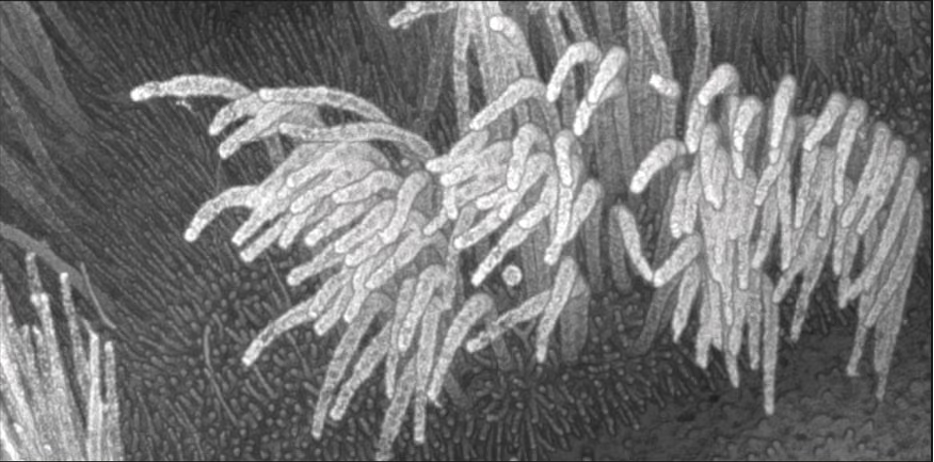
PRO-LONG CILIANALYSIS: Improved analysis of ciliary structure and function in Primary Ciliary Diskinesia
Developing improved microscopy techniques to analyse ciliary structure and function in Primary Ciliary Diskinesia
In this project, doctors, researchers, and companies are joining forces to improve the diagnosis and treatment of the rare lung disease Primary Ciliary Dyskinesia (PCD). PCD is an inherited condition in which the tiny hair-like structures in the airways, called cilia, do not move properly. Normally, these cilia help clear mucus and germs from the lungs. When they don’t function well, people with PCD often suffer from repeated respiratory infections, chronic coughing, and may develop permanent lung damage over time.
PCD affects about 1 in 10,000 people. Because the disease has many different forms and is difficult to recognize, it often takes years before the correct diagnosis is made. Current diagnostic techniques, such as electron microscopy, are expensive, time-consuming, and may miss subtle abnormalities. As a result, patients do not always receive the right care in time. A faster and more accurate diagnosis could prevent serious health problems and reduce healthcare costs.
To address this, the project explores whether modern microscopy techniques — expansion microscopy and light-sheet microscopy — can make cilia more visible and reveal more detail about their structure and movement. These methods may also help determine whether new treatments are truly effective.
Several partners are combining their expertise for this research: Amsterdam UMC contributes clinical knowledge of PCD, UMC Utrecht provides experience with cell models and therapies, Utrecht University brings advanced microscopy expertise, Visualise.bio supports the automation of expansion microscopy, and Zeiss advises on light-sheet microscopy. Through this collaboration, we aim to achieve faster and more reliable diagnoses and to better evaluate new treatments — contributing to improved care and quality of life for people with PCD.
Andere projecten
In elk PPS-project werken kennisinstellingen, bedrijven en zorgpartijen samen aan een concrete gezondheidsvraag. Bekijk het volledige projectoverzicht.
Bekijk de programma’s
Binnen onze programma’s werken bedrijven, kennisinstellingen en regionale partners samen aan innovaties die bijdragen aan betere gezondheid en zorg.
Bekijk de partnerschappen
Strategische publiek-private partnerschappen (PPP's) zijn meerjarige samenwerkingen tussen bedrijven, kennisinstellingen en andere partijen.
Hoe kunnen we je helpen?
Heb je een vraag of wil je meer weten over Health Holland? We brengen je graag in contact met de juiste mensen, kennis en mogelijkheden om gezondheidsinnovatie te versnellen.
We hebben uw bericht ontvangen
We nemen binnen 3 tot 4 werkdagen contact met je op. Is je vraag dringend? Neem dan gerust direct contact met ons op. Hieronder zie je de contactoptie die het beste past bij je onderwerp.
Opnieuw beginnen
Er ging iets mis bij het versturen van het formulier. Probeer het opnieuw.